
Election Denialists' Obsession with Georgia Is Fueled by Narratives From Gateway Pundit
A small number of hyper-partisan news blogs, activist groups, and online conspiracy theorists have shaped electoral discourse in Trump’s second term
TLDR
Partisan “election integrity” activists have sustained their focus on Georgia since President Donald Trump narrowly lost the state in the 2020 presidential election, working to undermine public faith in voting processes, state officials, and legal systems.
As the United States prepares for its 2026 midterm elections, Open Measures examined Georgia-centric election denialist discourse on four platforms that have historically harbored proponents of similar narratives.
Our researchers found that a small number of hyper-partisan news blogs and activist groups played a significant role in shaping the discussion of Georgia-centric election denialism.
Many of the most-active accounts sowing doubts about the legitimacy of Georgia elections were also found to have promoted extreme conspiracy theories like QAnon.
Background
After President Donald Trump narrowly lost Georgia to former President Joe Biden in the 2020 presidential election, Trump and his political allies falsely claimed that reported vote totals were illegitimate due to widespread fraud and pressured Georgia officials to overturn the results.¹ Though every audit, recount, lawsuit, and law enforcement investigation into those accusations has thoroughly dispelled them, the Trump Administration and its activist supporters have remained fixated on far-fetched conspiracy theories alleging corruption in Georgia’s elections.²
Since the 2020 election, self-described “election integrity” activists in Georgia have sought to undermine public confidence in the state’s elections by challenging voter registrations and lobbying for changes to election laws they believe would advantage Republican candidates, reflecting national efforts to do the same.³ Aligned with these efforts, some have sought to advance their cause by working for the second Trump Administration, which seized thousands of ballots from election offices in Fulton County in January 2026, pursuant to claims a local denialist group published only weeks earlier.⁴
False accusations about election integrity have also created unprecedented risks to election workers across the US,⁵ with Georgian poll workers, public officials, and their respective offices receiving violent threats.⁶ Others have been targeted by partisan media figures in defamatory smear campaigns, resulting in online threats and harassment.⁷
Ahead of 2026 midterm elections, Open Measures examined the state of Georgia-centric election denialism on four platforms where election denialist movements have historically disseminated propaganda and organized in the last year: Gab, Gettr, Telegram, and Truth Social.
Methodology
To begin, our researchers submitted crawl requests to our platform for posts mentioning Georgia’s top election officials, “election integrity” activist organizations, and government entities. Next, we created a search string to identify election denialist posts made since President Donald Trump began his second term on Jan. 20, 2025, using the following query:
Analysis
Our search query identified more than 19,000 posts made across the four platforms we examined. With our platform’s recently updated Timeline tool, we visualized how many of those posts were made each day during our analysis period.
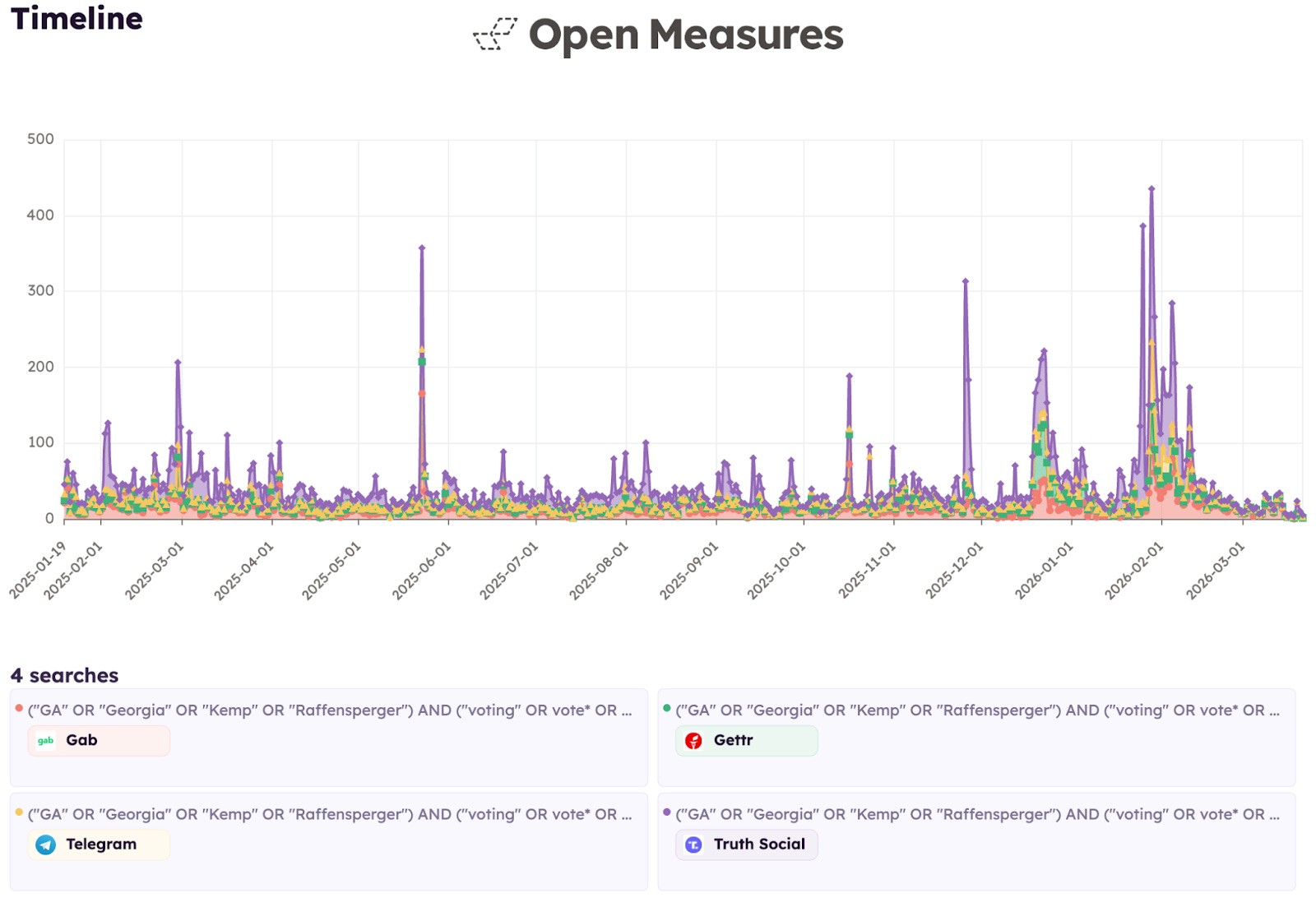
Caption: A Timeline chart shows the number of posts shared per day on Gab, Gettr, Telegram, and Truth Social that matched our search query between Jan. 20, 2025, and Mar. 22, 2026.
Among these posts, discussion about voting in Georgia remained fairly constant throughout Trump’s second term but surged at several points in our analysis period. Upon closer examination, we found the largest spikes appeared to be driven by inflammatory articles on hyper-partisan news blogs and statements from public officials.
Our researchers saw increased activity following news developments related to Georgia politician and voting rights activist Stacey Abrams, the dismissal of criminal charges against Trump related to his efforts to overturn the 2020 presidential election, and instances where public officials claimed state electoral processes had suffered from administrative errors.
The largest uptick in daily posts our researchers observed, both in size and duration, corresponded to the Trump Administration’s raid of Fulton County’s electoral offices on Jan. 28, 2026. about 18% of all posts included in our analysis were shared since the raid occurred.
Partisan Blogs and Activist Groups Shape Election Denialism about Georgia
For each platform, we used our platform’s Activity feature to identify users whose posts matched our query most frequently during our analysis period, as well as which URLs were included most frequently in those posts. Similar to our previous reporting about election denialism in Michigan, we found that similar discourse about Georgia had been heavily shaped by a handful of hyper-partisan news blogs and right-wing activist groups.
On Truth Social, where we identified the greatest number of posts, at least 746 included links directing to The Gateway Pundit, a pro-Trump news blog notorious for promoting conspiracy theories about elections (nearly 9% of all Truth Social posts we identified).⁸ We observed similar trends on other platforms we analyzed, with more than 10% of all posts we identified containing a link to the Gateway Pundit.
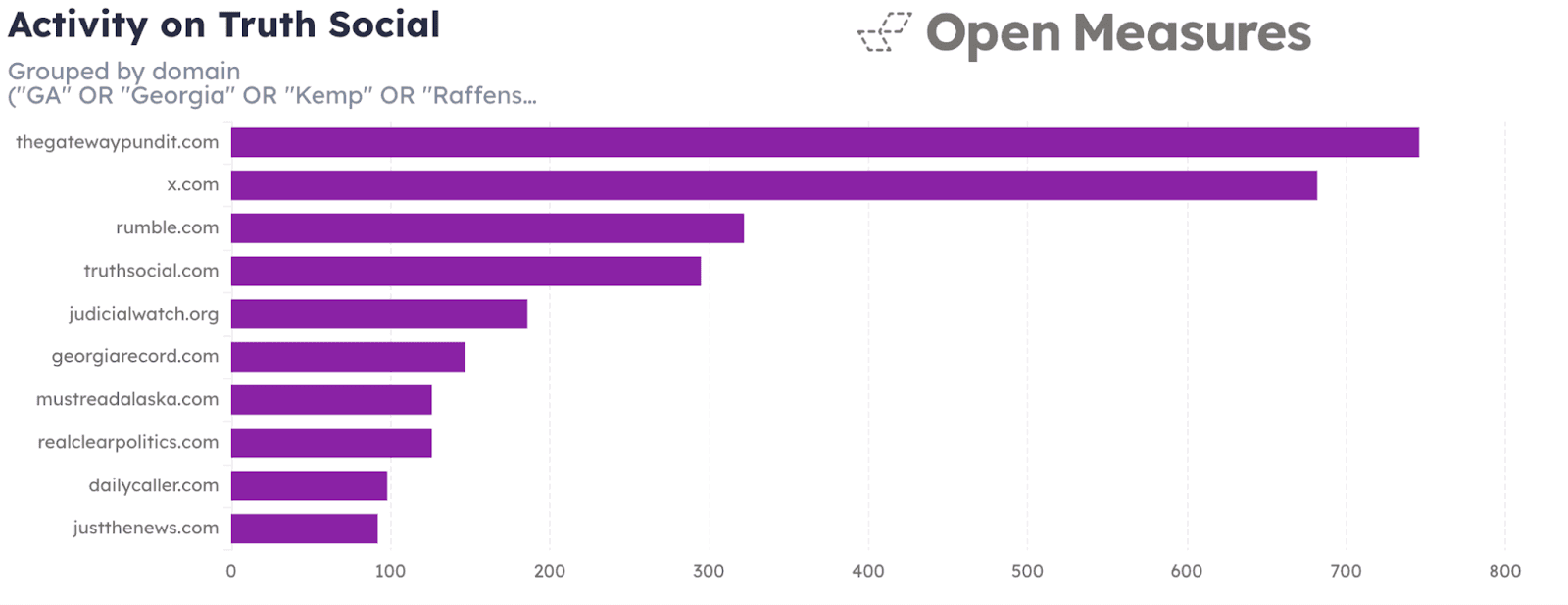
Caption: An Activity graph shows the 10 most frequently-linked domains contained in Truth Social posts we identified made between Jan. 20, 2025, and Mar. 22, 2026.
On Gab, from which we identified our second-greatest number of posts, only Rumble – an alternative video platform popular with conspiracy theorist content creators – was more frequently linked-to than the Gateway Pundit. Rumble links appeared in at least 1,662 Gab posts, representing more than 28% of all posts from the platform that we identified.
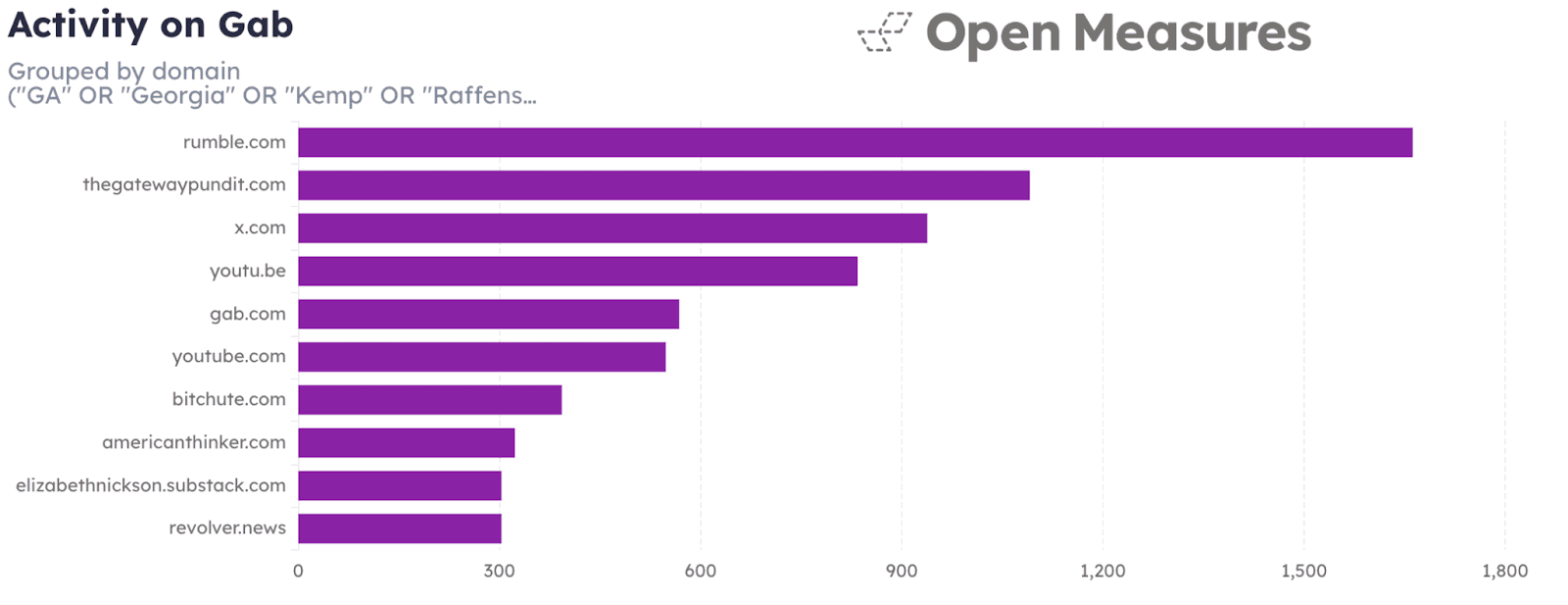
An Activity graph shows the 10 most frequently-linked domains contained in Gab posts we identified made between Jan. 20, 2025, and Mar. 22, 2026.
Super-Spreaders of Georgia’s Election Denialism
To determine which accounts most frequently spread doubts about the integrity of Georgia’s elections, our researchers applied a search filter removing results with fewer than 10 re-shares. On each platform, they observed that the accounts posting the most election denialist content related to Georgia were also frequent proponents of other conspiracy theories, like QAnon.
On most platforms, the accounts that posted most frequently appeared to be random users. On Truth Social, however, similar accounts we identified included niche conspiracy theorist influencers, like QAnon promoter Cornelia DiNunzio, and pro-Trump media outlets Real America’s Voice and LindellTV.
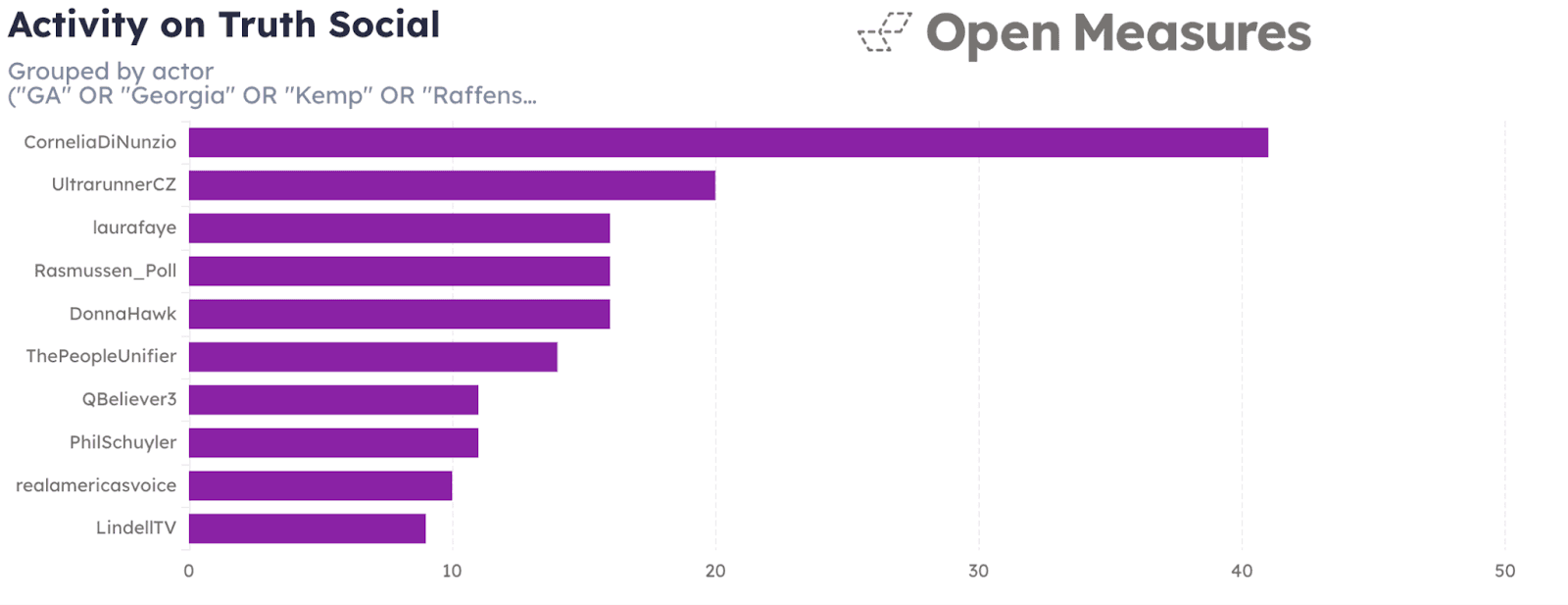
Caption: An Activity graph shows the 10 Truth Social accounts whose posts between Jan. 20, 2025, and Mar. 22, 2026 matched our query most frequently and received 10 or more re-shares.
To identify the loudest promoters of election denialism related to Georgia, our researchers adjusted the filter again to only show posts with 500 or more re-shares. We used our platform’s Discover feature to manually review the resulting 61 posts.
The most-reshared post identified by our search query was shared by a far-right Telegram channel on June 10, 2025. That post, re-shared nearly 8,600 times, listed world events supposedly “proving” various QAnon conspiracy theories true, including a claim that the 2020 election was “fake.” While the post included claims related to Georgia, it did not make specific claims about the state’s elections.
The second-most re-shared post came from President Trump’s Truth Social account on Nov. 26, 2025, made after a Georgia prosecutor filed to drop criminal charges filed against Trump two years earlier in relation to his efforts to overturn the results of the state’s 2020 presidential election.⁹ In that post, which was re-shared more than 7,400 times, Trump claimed the state’s charges against him were retaliation for “telling the TRUTH” that the 2020 election had been “RIGGED AND STOLEN.”
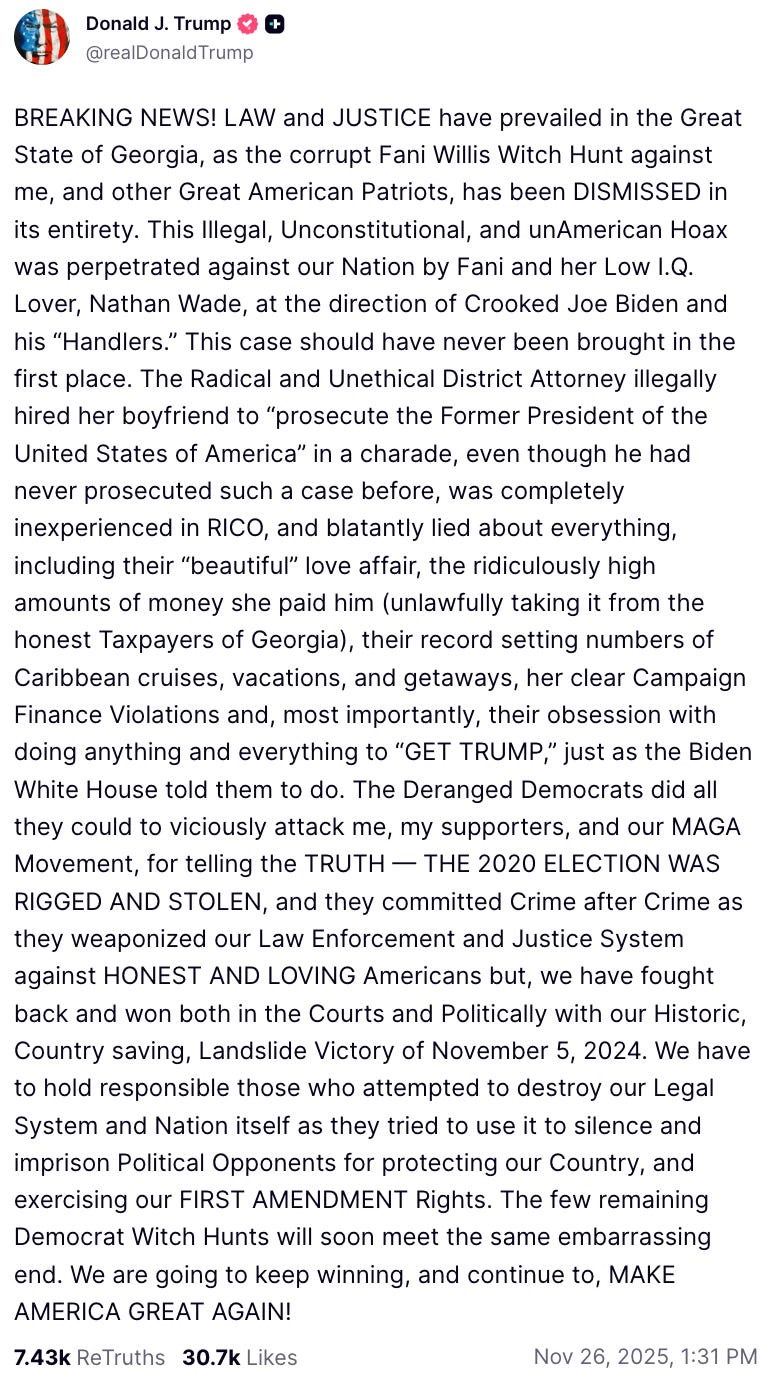
Caption: A Truth Social post shared by President Donald Trump on Nov. 26, 2026, celebrates the dismissal of criminal charges brought against him in Georgia over his efforts to overturn the results of the state’s 2020 presidential election. Trump claimed Georgia prosecutors sought to punish him for telling the “TRUTH” that the 2020 election had been “RIGGED AND STOLEN.”
The most re-shared Truth Social post we identified from an account other than Trump’s was made by pro-Trump social media personality Rogan O’Handley (aka “DC_Draino”) on Feb. 19, 2026. O’Handley’s post, which was shared nearly 1,600 times, asserted a “direct correlation” between the Trump Administration’s raid on Fulton County elections offices and top Democratic Party figures’ campaign messaging ahead of 2026 midterm elections.
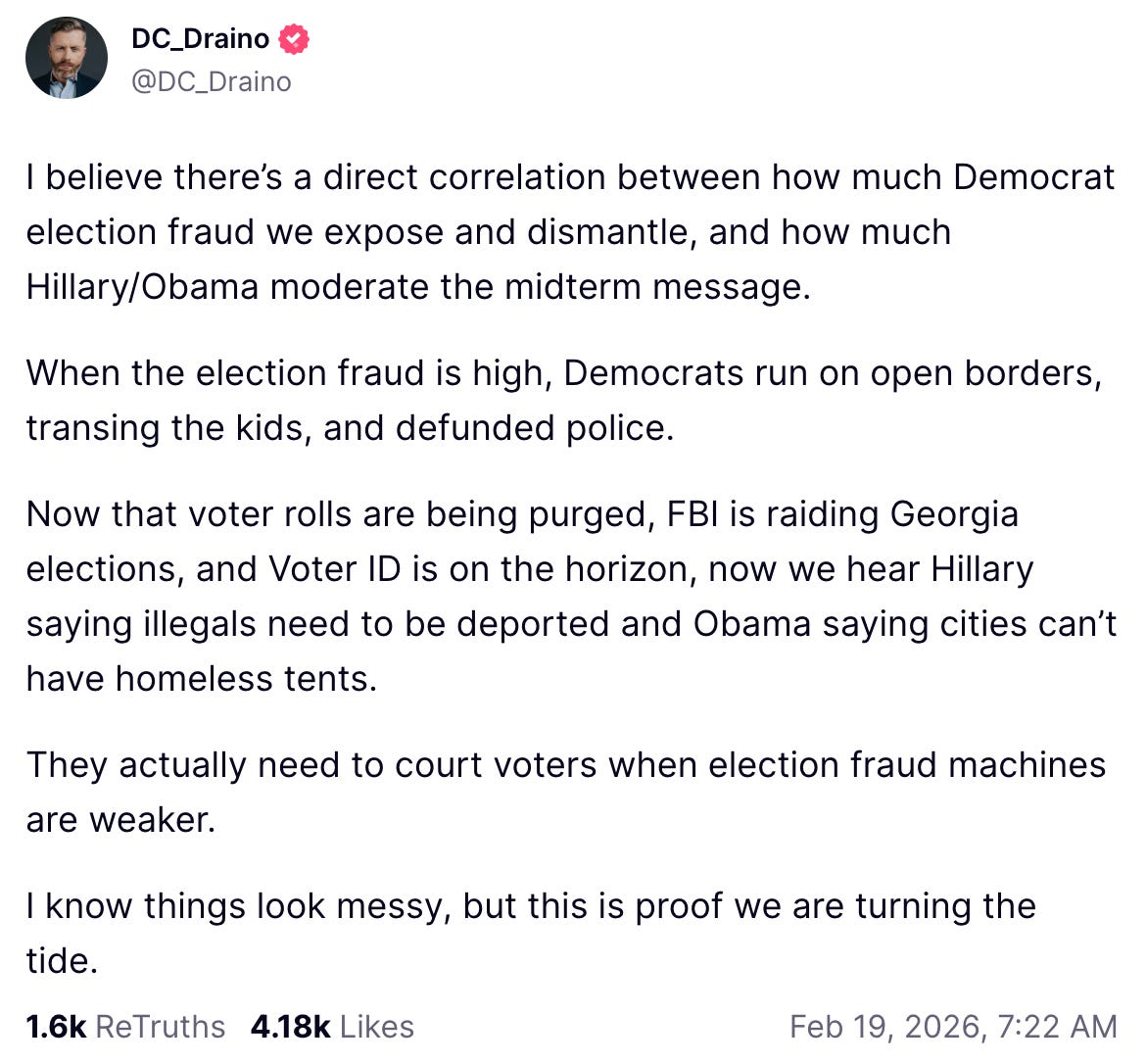
Caption: A Truth Social post made by Rogan O’Handley (aka “DC_Draino”) on Feb. 19, 2026, asserting a “direct correlation” between the Trump Administration’s raid of Fulton County election offices and Democrats’ campaign messaging ahead of 2026 midterm elections.
Conclusion
Open Measures found that a relatively small number of actors had outsized influence shaping election denialist discourse related to Georgia’s elections on platforms where election denialist movements had historically been most active.
Misinformation and conspiracy theories about elections continue to drive threats against officials, animate efforts to restrict ballot access, and undermine public confidence in democracy. Increased awareness about the networks of influence driving election misinformation may help inform efforts to protect voting. As such, we will continue to monitor and report on these trends as they develop and encourage other researchers to do the same using Open Measures’ platform.
Citations
Scott Pelley, Aliza Chasan, Henry Schuster, and Sarah Turcotte. “Georgia election officials defend voting system against barrage of false claims, conspiracy theories.” CBS News. 3 Nov. 2024. Here.
Jane C. Timm. “Election officials push back against Trump administration after Fulton County raid and voter roll demands.” NBC News. 29 Jan. 2026. Here.
Justin Glawe and Ari Berman. “How Election Deniers Took Over Georgia’s Election System.” Mother Jones. 31 Oct. 2024. Here.
Hunter Walker. “A Conspiracy Fueled Report Preceded ‘Black Pill’ Tulsi Gabbard’s Fulton County Election Raid.” Talking Points Memo. 6 Feb. 2026. Here.
Andrew Howard. “Election officials grapple with a brain drain as threats rise.” Politico. 3 Feb. 2026. Here.
Olivia Rubin, Tonya Simpson, Tomas Navia, and Cho Park. “Protecting Your Vote: Georgia election workers prepare for election under cloud of threats.” ABC News. 6 Oct. 2024. Here.
Johnny Kauffman. “’You Better Run’: After Trump’s False Attacks, Election Workers Faced Threats.” NPR. 5 Feb. 2021. Here.
Huo Jingnan. “Gateway Pundit files for bankruptcy after election conspiracy defamation lawsuits.” NPR. 24 April 2024. Here.
Liz Landers. “Final criminal case against Trump dismissed after Georgia prosecutor drops charges.” PBS News. 26 Nov. 2025. Here.
Identify online risks with the Open Measures platform.
Organizations use Open Measures every day to track trends related to networks of influence, coordinated harassment campaigns, and state- backed info ops. Click here to book a demo.