
Conspiracy Theories About Bill Gates See Revival Following ‘Epstein Files’ Release
Far-right communities weave new documents into their years-long fixation on the Microsoft co-founder’s philanthropy

TLDR
Conspiracy theorists have spent years fixated on Bill Gates, the billionaire co-founder of Microsoft. The most popular theories have centered on Gates’ philanthropic giving and, more recently, his relationship to Jeffrey Epstein.
Open Measures saw discussion of Gates surge on platforms harboring far-right conspiracist communities in late January after the Department of Justice published millions of previously unseen documents pertaining to Epstein, including emails Epstein exchanged with Gates and his top confidantes.
Researchers saw users in conspiracy theorist communities capitalize on renewed interest in Gates’ relationship with Epstein, weaving the new material into their existing theories and citing them as proof of long-debunked claims.
Background
Conspiracy theorist media personalities, far-right online communities, and hostile state actors have spread theories about Bill Gates, the billionaire co-founder of Microsoft, for years.¹ Many of the most-circulated theories have taken aim at Gates’ philanthropic support for global health programs, claiming his advocacy is guided by sinister ulterior agendas like reducing the global population and amassing power for a cabal of authoritarian liberal elites seeking world domination.²
As Gates’ charitable foundation disbursed billions of dollars to entities that led the worldwide response to the COVID-19 pandemic, conspiracy theories about the motives driving his philanthropy saw widespread circulation on social media.³ At the same time, Gates faced increased scrutiny over his ties to child sex offender Jeffrey Epstein, whose reported suicide in 2019 inspired countless viral conspiracy theories about the global elites with whom he’d been known to associate.⁴
Members of Congress and the Department of Justice (DOJ) have published several batches of previously private or classified documents related to Epstein in recent months, colloquially dubbed the “Epstein Files.” Among the millions of documents included in those releases were photos and email records revealing new details about Gates’ long-reported ties to Epstein.⁵
Documents published by the DOJ on Jan. 30 included records of emails Epstein exchanged with Gates and several of his top confidantes, who he hoped to convince to create a donor-advised fund for his charitable foundation. As Gates’ initial interest in the idea faded and his communication with Epstein stopped, emails suggest that Epstein attempted to insert himself into Gates’ marital issues. As Epstein’s pitches to Gates began to fizzle, Epstein drafted two emails in which he claimed he facilitated sexual encounters for Gates and helped him hide a sexually transmitted disease from his then-wife, Melinda Gates.⁶ (Gates has strongly denied those claims, and none of Epstein’s known victims have accused Gates of wrongdoing.⁷)
Social media influencers and online communities who previously promoted conspiracy theories and false claims about Gates capitalized on new details revealed in the Epstein Files, attempting to link old conspiracy theories about Gates’ support for COVID-19 pandemic response to newer narratives about Epstein.⁸
Methodology
Our researchers sought to better understand how new revelations about Gates’ and Epstein’s relationship impacted the spread of existing conspiracy theories about Gates. They began their analysis by searching our platform for posts that mentioned Gates by name since Dec. 12, 2025 – when lawmakers shared previously unseen materials from Epstein’s estate⁹ – across 11 distinct platforms where conspiracist right-wing communities have historically gathered. They identified more than 26,000 posts that mentioned Gates in the analysis period, including:
More than 10,500 posts on the microblogging platforms Gab, Gettr, MeWe, Minds, and Truth Social
More than 10,400 post on the video-based platforms Bitchute, LBRY, and Rumble
More than 5,300 posts on the forum boards 4chan, 8kun, and Scored
From there, our researchers created search strings to narrow the results for further analysis. To identify posts that mentioned both Gates and Epstein, they used the following search string:
To identify posts that mentioned both Gates and at least one keyword related to previously documented conspiracy theories about his philanthropy (including those related to COVID-19), they used this search string:
Analysis
Open Measures researchers used the recently enhanced Timeline tool to visualize their search results – quantifying the posts made each day that matched their search strings, clustering them by platform type, and graphing them over our analysis period. Viewed this way, we saw major spikes across the platforms we analyzed in late January and early February, coinciding with the DOJ’s “Epstein Files” release on Jan. 30.
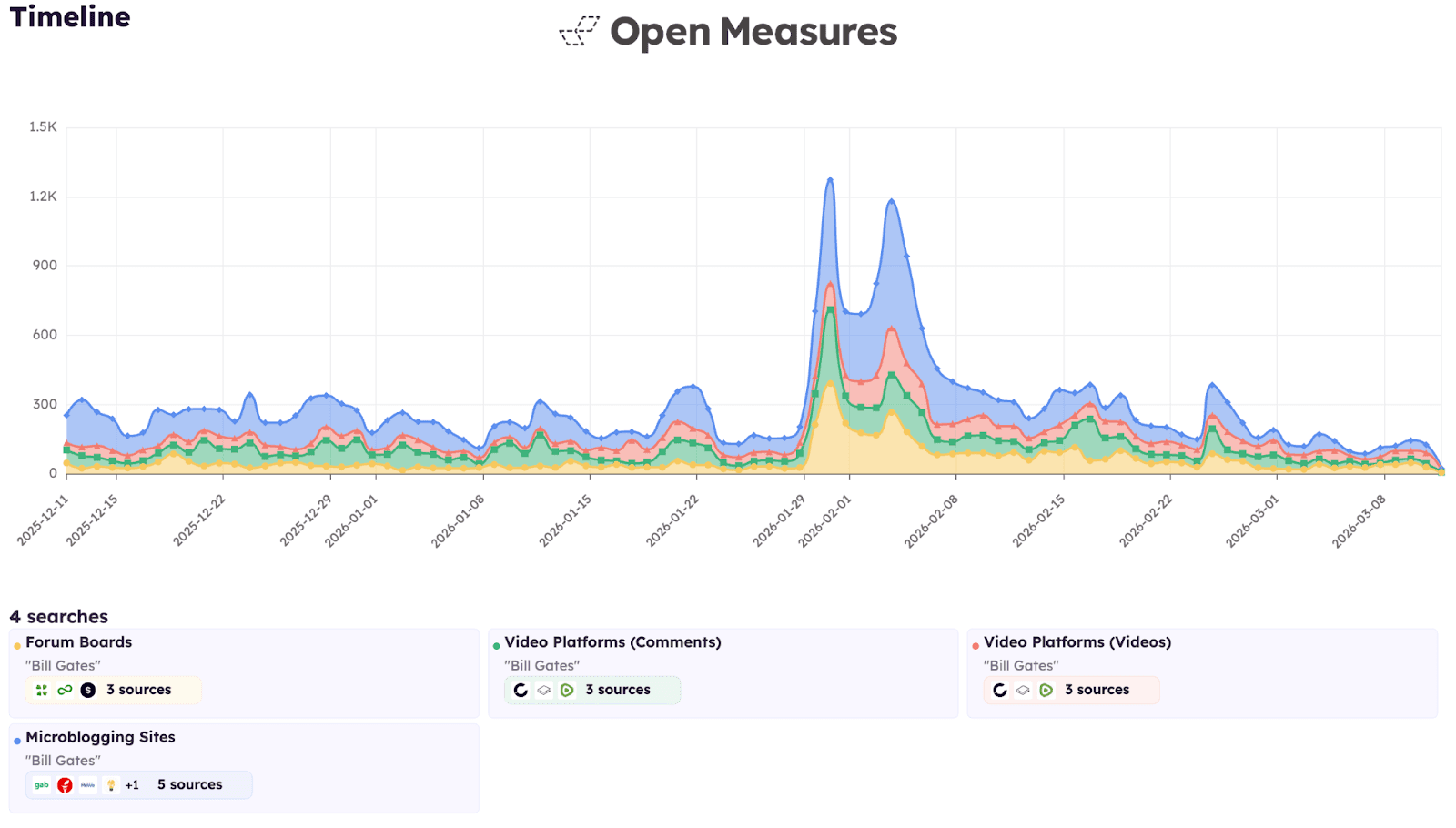
Caption: A Timeline chart shows the daily number of posts mentioning Bill Gates across 11 distinct platforms, grouped by platform type, since Dec. 12, 2026.
When researchers narrowed their search query to only return posts where Gates and Epstein were mentioned together, they saw more than half of the posts that mentioned Gates since Jan. 30 also mentioned Epstein. The number of daily posts mentioning both Gates and Epstein were curiously minimal prior to that surge – even after lawmakers published photos of Gates obtained from Epstein’s estate in December 2025. Prior to the document dump, less than 12% of posts that named Gates also mentioned Epstein.
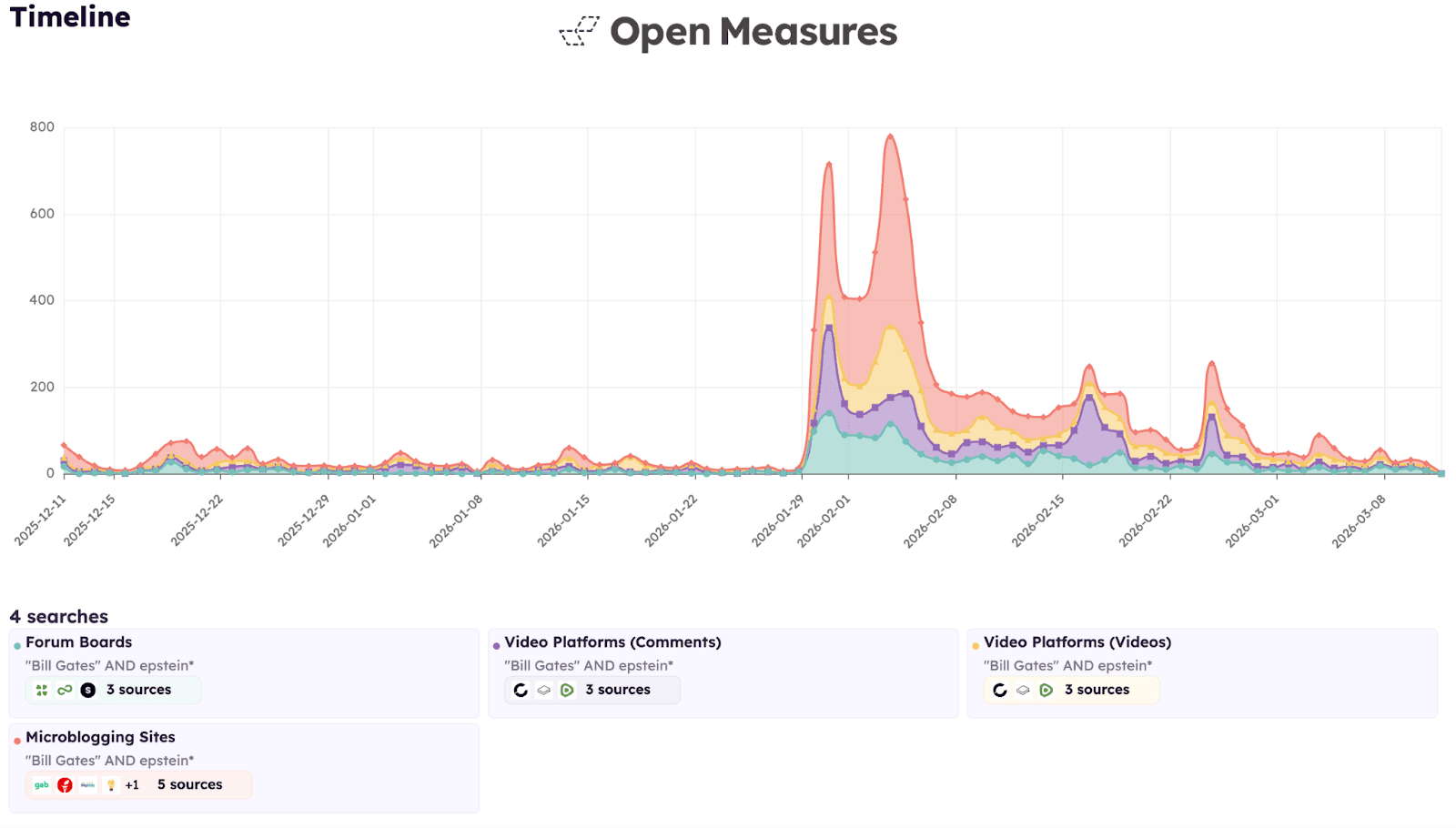
Caption: A Timeline chart shows the daily number of posts mentioning Bill Gates and Jeffrey Epstein across 11 distinct platforms, grouped by platform type, since Dec. 12, 2026.
Comparatively, we found that more than 40% of the posts that mentioned Gates prior to Jan. 30 also included at least one of the terms included in our search string related to conspiracy theories surrounding his philanthropy. The daily volume of those posts also spiked after the January “Epstein Files” release, but generally appeared at more consistent rates throughout the analysis period.
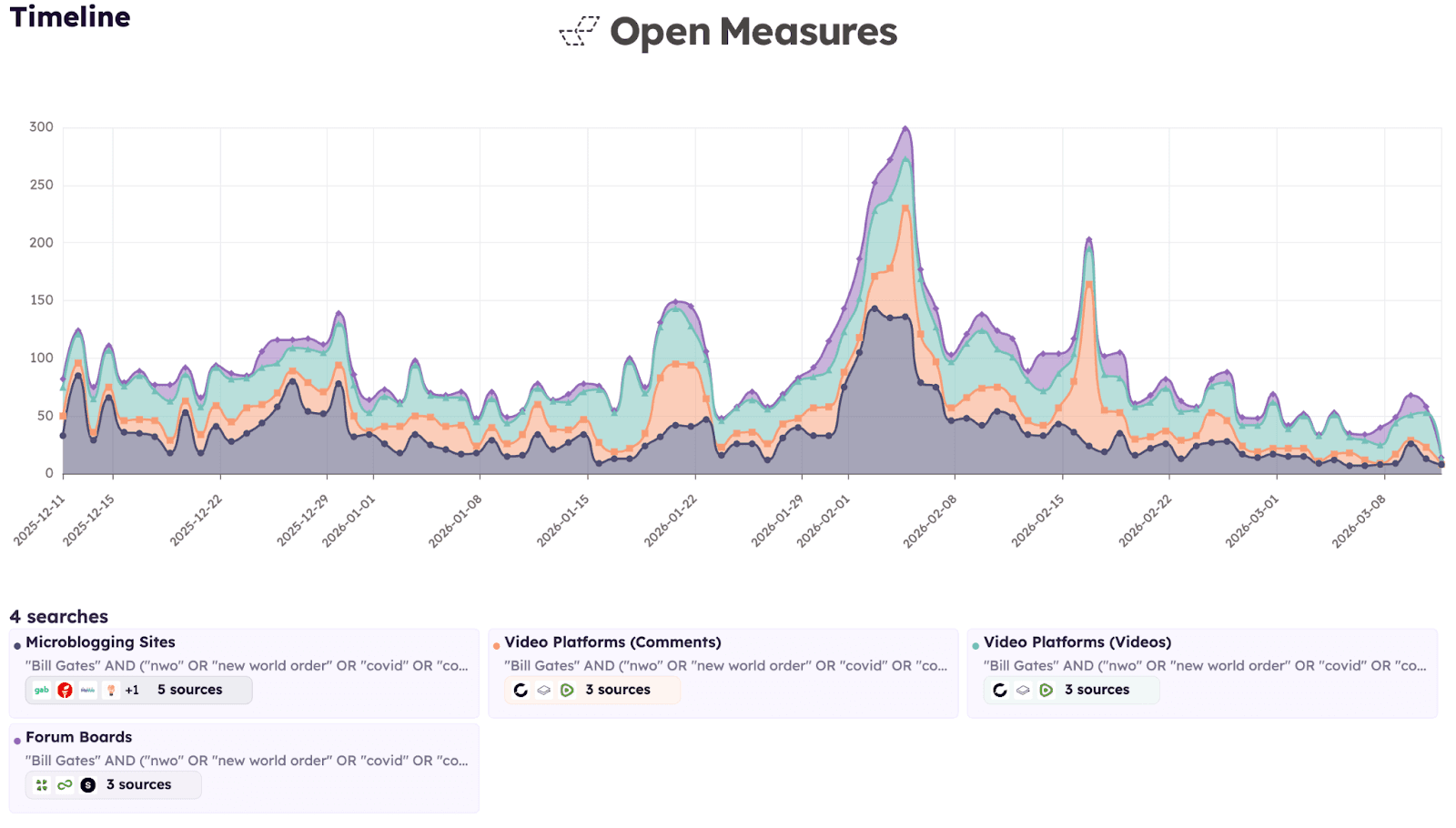
Caption: A Timeline chart shows the daily number of posts mentioning Bill Gates and at least one term related to conspiracy theories about Gates’ philanthropy across 11 distinct platforms, grouped by platform type, since Dec. 12, 2026.
Researchers combined the two prior search strings to chart posts that mentioned Gates and Epstein together and also included a keyword related to conspiracy theories about Gates. Some of the spikes we observed appeared to be driven by posts attempting to link the two subjects together. The highest saturation of these posts were seen on video-based and microblogging platforms, where more than 18% and 16% of posts made since Jan. 30 mentioned Epstein in relation to longstanding conspiracy theories about Gates.
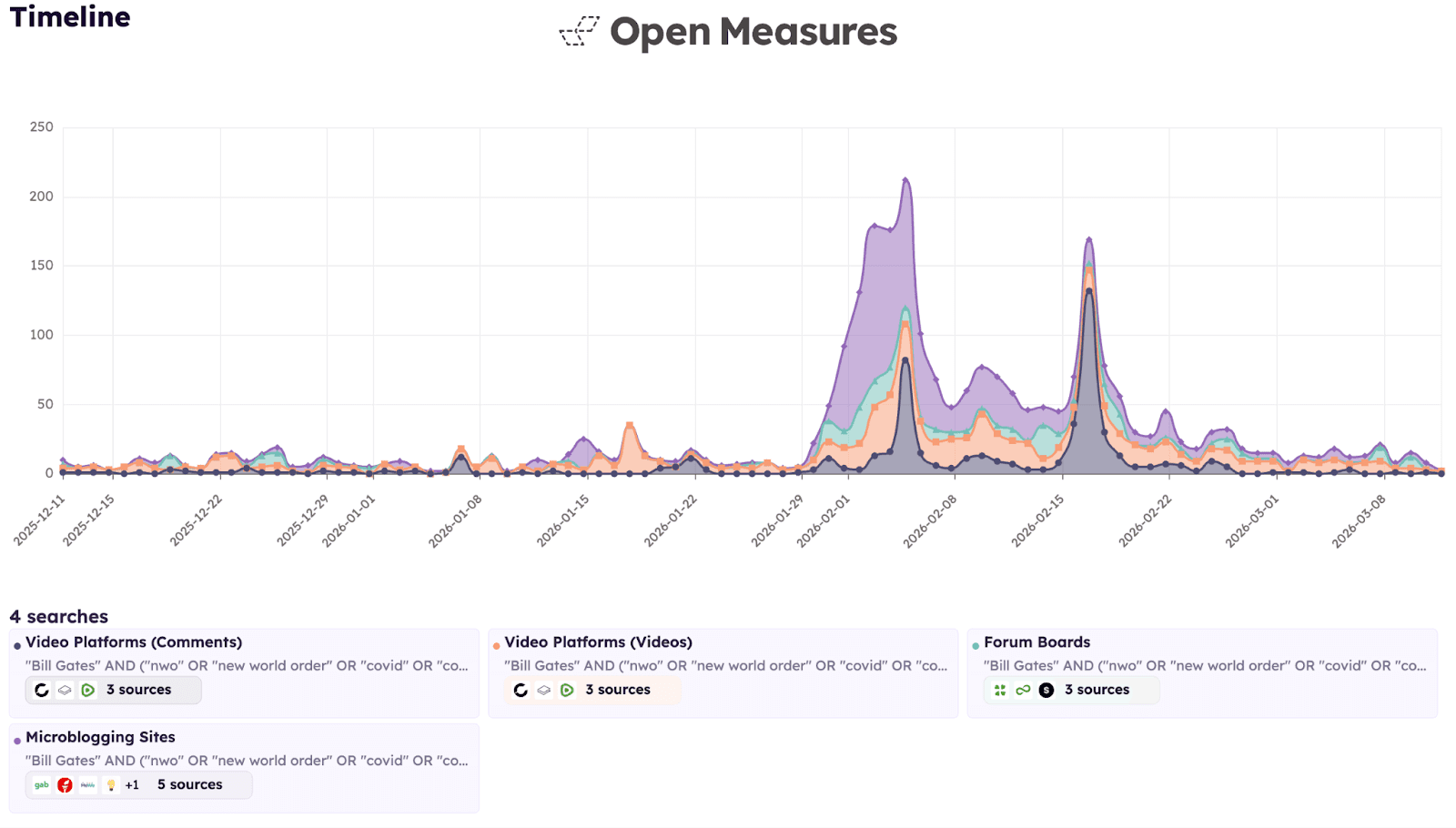
Caption: A Timeline chart shows the daily number of posts mentioning Bill Gates, Jeffrey Epstein, and at least one term related to conspiracy theories about Gates’ philanthropy across 11 distinct platforms, grouped by platform type, since Dec. 12, 2026.
A review of those posts found that most of the users who shared them promoted debunked claims that materials in the Epstein Files proved Epstein had prior knowledge of the pandemic.
Conclusion
Our findings illustrate how conspiracy theorist communities fold new information and developing events into their existing narratives about their targets. Gates’ relationship to Epstein had no provable impact on Gates’ philanthropic work or his support for global disease response efforts, yet communities that have promoted conspiracy theories about the latter eagerly used newly revealed information from the Epstein Files to rehash and expand on prior claims.
This research underscores the importance of long-term monitoring for individuals who have been targeted by harmful activity online. Open Measures builds tools that help researchers track and analyze activity across dozens of alternative platforms, which often play outsized roles in the proliferation of digital safety risks.
Citations
Bret Schafer, Amber Frankland, Nathan Kohlenberg, and Etienne Soula. “Influence-enza: How Russia, China, and Iran Have Shaped and Manipulated Coronavirus Vaccine Narratives.” Alliance for Securing Democracy. 6 March 2021. Here.
Jane Wakefield. “How Bill Gates became the voodoo doll of Covid conspiracies.” BBC News. 5 June 2020. Here.
Daisuke Wakabayashi, Davey Alba, and Marc Tracy. “Bill Gates, at Odds With Trump on Virus, Becomes a Right-Wing Target.” The New York Times. 17 April 2020. Here.
Emily Flitter and James B. Stewart. “Bill Gates Met With Jeffrey Epstein Many Times, Despite His Past.” The New York Times. 12 Oct. 2019. Here.
Richard Luscombe. “Bill Gates says he ‘regrets’ knowing Epstein as ex-wife alludes to ‘muck’ in marriage.” The Guardian. 4 Feb. 2026. Here.
Michael Kavate. “What Did Bill Gates Do with Jeffrey Epstein? Here’s What the Emails Say.” Inside Philanthropy. 11 Feb. 2026. Here.
Ben Hatton. “Bill Gates ‘took responsibility’ over Epstein ties in staff meeting, foundation says.” BBC News. 25 Feb. 2026. Here.
Harshana Silva. “Posts falsely link email in Epstein files to Covid conspiracy.” AFP. 13 March 2026. Here.
Carmen Paun. “Bill Gates appears in newly released photos from Epstein estate.” Politico. 12 Dec. 2025. Here.
Identify online risks with the Open Measures platform.
Organizations use Open Measures every day to track trends related to networks of influence, coordinated harassment campaigns, and state- backed info ops. Click here to book a demo.