
Pro-Trump Communities Spent Years Claiming Elections Were ‘Rigged.’ Now They Support Gerrymandering.
Users on platforms where election conspiracy theories have spread are rallying behind partisan redistricting efforts ahead of 2026 midterms
TLDR
State lawmakers across the United States are rushing to voluntarily implement new electoral district maps, hoping to create advantages for their respective parties ahead of 2026 midterm elections – a naked effort at partisan gerrymandering. Over the last year, President Donald Trump has pressured Republican state lawmakers to voluntarily redraw their maps in order to help Republicans defend their narrow majority in the US House of Representatives.
Republican politicians and their social media influencer supporters have attempted to drum up support for their partisan gerrymandering efforts online, including in communities that have historically promoted conspiratorial narratives alleging elections are rigged against Trump and his political allies.
Open Measures identified four prominent narratives that right-wing influencers have promoted to garner support for partisan gerrymandering efforts.
Background
Redistricting is the process of reestablishing the geographical boundaries of electoral districts in each state. States are legally required to redraw their district maps once per decade, following the results of the federal census, to account for population shifts and ensure that each district represents roughly the same number of residents.
Unlike other countries that assign the process to independent, non-partisan commissions, redistricting in the United States is performed by each state’s own elected officials, who often strategically redraw electoral maps to their own political advantage (a practice known as gerrymandering).¹ Throughout US history, politicians have used partisan gerrymandering to defy voters’ preferences, protect incumbent politicians from potential challengers, and manipulate the electoral impacts of racial and ethnic minority groups.²
President Donald Trump urged Republican state lawmakers in Texas to voluntarily redraw their electoral maps last summer with the explicit goal of creating more Republican-leaning districts in order to help defend their party’s narrow majority in the US House of Representatives in the 2026 midterms.³ Texas officials obliged the request, setting off a larger wave of partisan redistricting efforts across the country.⁴
These efforts intensified in late April, after the US Supreme Court issued a ruling that effectively demolished provisions in the Voting Rights Act that prohibit racial gerrymandering. In light of that Supreme Court decision, Republican lawmakers in Tennessee passed new electoral maps that eliminated districts where a majority of voters were Black. Other Republican-led states have reportedly debated doing the same.⁵
Polls show that a majority of Americans are opposed to gerrymandering; more than two-thirds of respondents to an August 2025 YouGov survey said it should be illegal.⁶ Gerrymandering has been found to damage public faith in democracy and fuel doubts about election integrity.⁷
Methodology
Open Measures sought to identify posts discussing recent redistricting efforts on five text-based alternative platforms where election denialist movements and their supporters have historically congregated: Gab, Gettr, Telegram, Truth Social, and Scored.
To identify relevant posts, our researchers created a search query including terms referring to redistricting shared over the last year (between May 13, 2025 and May 13, 2026):
From the query results, our researchers used proprietary data tools built into Open Measures’ platform to identify prominent narratives, actors, and themes.
Interest in Redistricting Surged Around Partisan Push
Open Measures found that users on the five platforms included in our analysis shared more than 80,000 total unique posts that contained a keyword related to redistricting over the last year. Nearly half of the results we identified were shared on Truth Social, an alternative microblogging platform Trump created after he was banned from mainstream platforms for inciting the 2021 riot at the US Capitol Building.⁸
Using our platform’s Timeline feature, we created a visualization of unique posts shared on each platform per week during our search period. Our researchers saw that increased discussion related to redistricting first occurred on Truth Social, as illustrated by an activity spike in August 2025, shortly after Trump asked Texas lawmakers to redraw their electoral maps. Discussion swelled at various points in the analysis period, typically coinciding with news reports about redistricting efforts across the US, and spiked again as the Supreme Court undercut the Voting Rights Act.
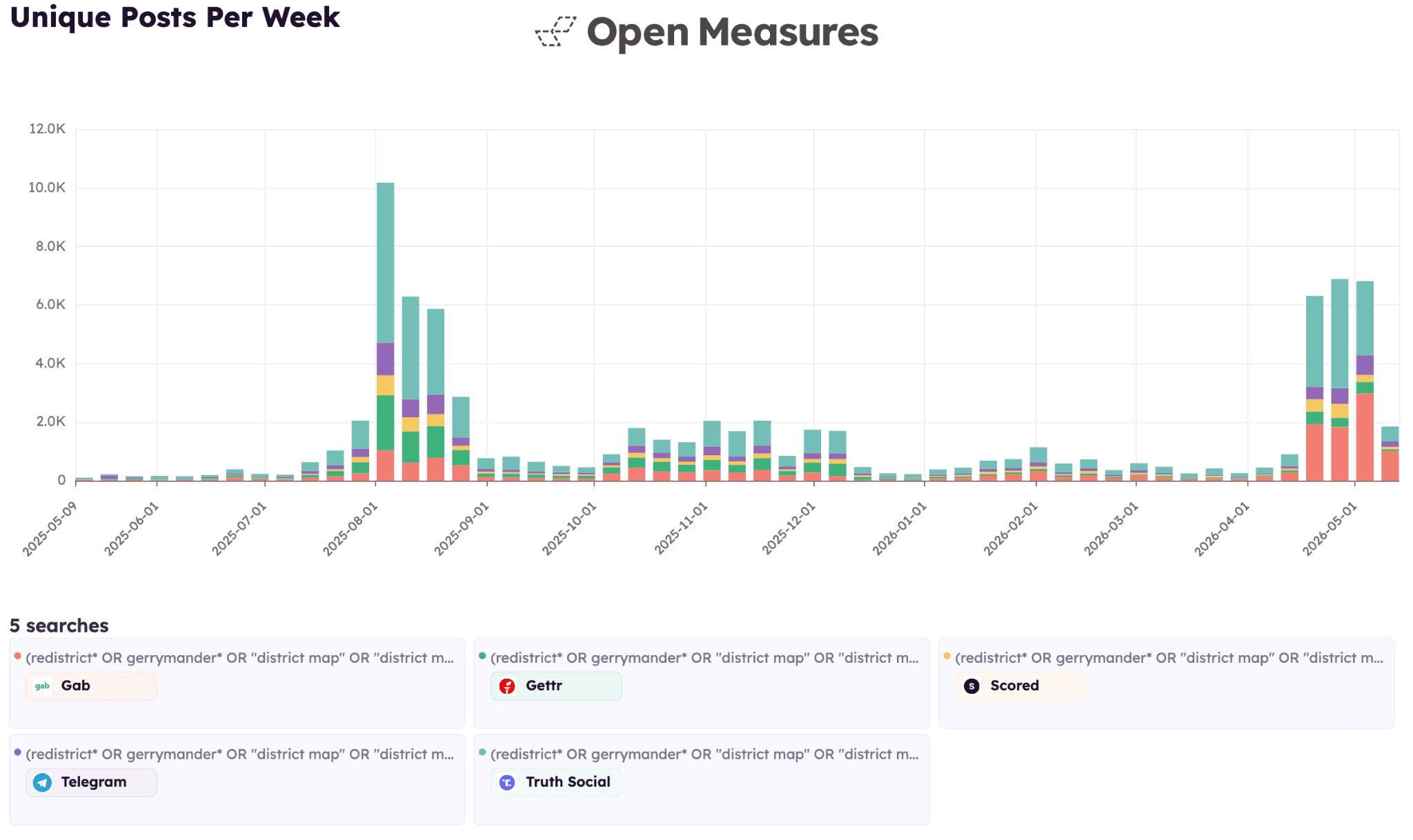
Caption: A Timeline chart shows the number of unique posts shared per week on Gab, Gettr, Scored, Telegram, and Truth Social that included a keyword related to redistricting between May 13, 2025, and May 13, 2026.
As seen in our prior analysis of election denialist communities, redistricting discussions on platforms we examined were largely driven by articles published by The Gateway Pundit, a hyper-partisan news blog known for publishing falsehoods and conspiracy theories about elections.⁹ When researchers used our Activity tool to identify the most-shared links in the posts their query identified, they saw the numbers of posts linking to Gateway Pundit articles vastly outnumbered those that linked to stories published by other sites.
On Truth Social, where we identified the most posts discussing redistricting, periods of increased discussion often followed Trump’s posts on the platform that mentioned the topic (which he referenced in at least 50 posts over the last year). Using the Activity tool to show which accounts on Truth Social shared the most posts that received 500 or more re-shares, we identified right-wing media outlets and influencers that frequently promoted conspiracy theories about elections were also among the top drivers of redistricting discussions.
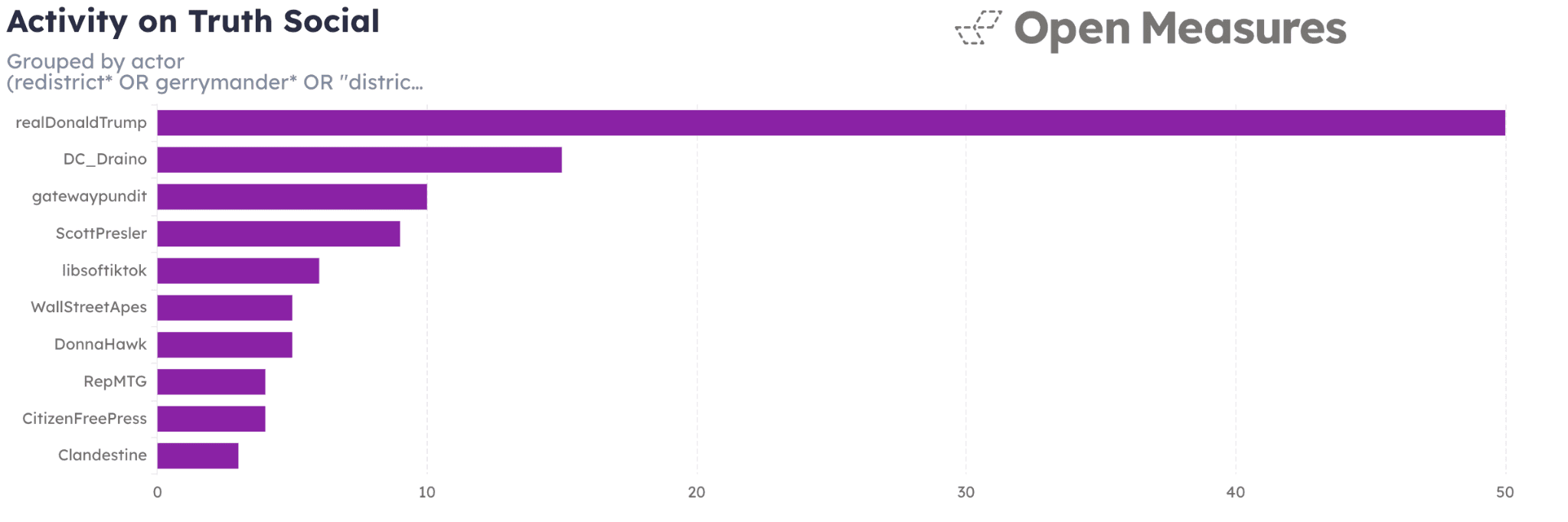
Caption: An Activity chart shows the ten Truth Social accounts that shared the highest numbers of unique posts mentioning keywords related to redistricting and received 500 or more re-shares on the platform between May 13, 2025, and May 13, 2026.
How Pro-Trump Communities Are Selling Partisan Gerrymandering Efforts
Pro-Trump communities have spent years promoting outlandish and conspiratorial claims that US elections are irredeemably corrupt – allegedly rigged by election administrators, voting machine manufacturers, non-profit advocacy groups, law enforcement agencies, and foreign governments in order to sabotage Republicans.¹⁰ But ahead of the 2026 midterm elections, the same communities have voiced overwhelming support for partisan gerrymandering efforts.
To gain a fuller context, our researchers reviewed posts our search query identified to assess prominent narratives that users of platforms we reviewed put forward to encourage support of Republican-led redistricting efforts. From our analysis, we identified four key themes.
Immigration Narratives
Pro-Trump influencers have argued that partisan redistricting efforts are necessary to offset the fact that federal census data includes counts of all people who reside in the country – including unauthorized immigrants (who, as non-citizens, are ineligible to vote). Our researchers saw that many posts promoting this argument reiterated talking points from the Trump Administration, framing partisan gerrymandering as a corrective measure meant to level the playing field for Republican candidates.
Last year, around the time Texas was drawing its new district maps, the Trump Administration also discussed ordering a “new” census that would exclude undocumented people from its totals.¹¹
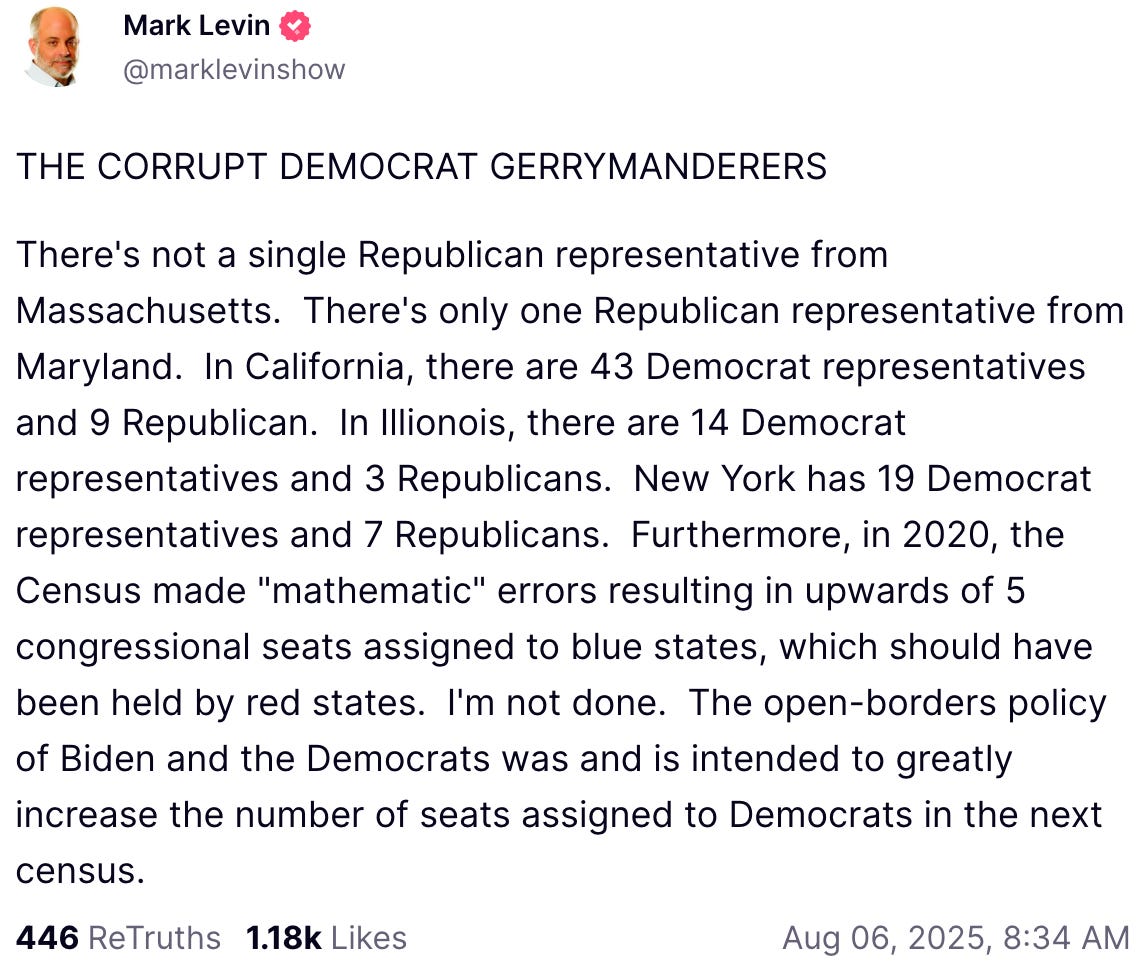
Caption: In a Truth Social post on Aug. 6, 2025, pro-Trump media personality Mark Levin says that Democrats were unjustly allocated “upwards of 5 congressional seats” due to US census “errors” and that their immigration policies are intended to award them additional seats in the next census.
Broader anti-immigrant sentiments also appeared to motivate users who voiced support for redistricting efforts ahead of midterms. Some argued that partisan gerrymandering was necessary to preserve Trump’s immigration agenda, as seen in this post on Gab, shared on April 23, 2026:
NewsFlash: I dislike “gerrymandering” however FL and SC must start their ‘map’ immediately as GOP can NOT loose what we’ve gain! GOP had to finish deporting ALL illegals as well as DACA and now anchor babies. Fact is they destroying all social programs as well as our educational systems.
Dominance Narratives
Many high-engagement posts related to redistricting that we identified argued that redrawing election maps was necessary to prevent Democrats from blocking the Trump Administration’s legislative agenda, impeaching Trump for a third time, and otherwise destroying the nation with their own political priorities.
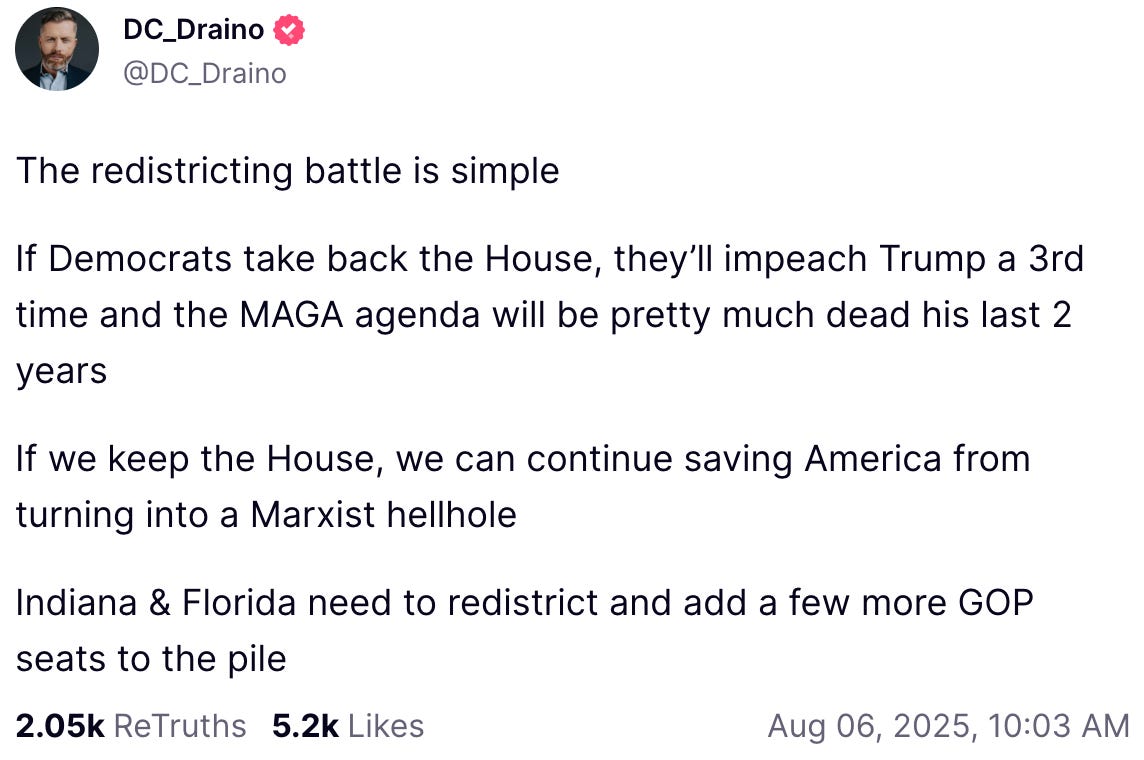
Caption: In a Truth Social post on Aug. 6, 2025, pro-Trump social media personality Rogan O’Handley (aka “DC_Draino”) argues that redistricting is necessary to prevent Democrats from turning the United States into “a Marxist hellhole.”
Posts promoting these narratives often framed redistricting as a non-ideal but necessary move to prevent damage to their own political movement and to prevent their political opponents from gaining power. One high-engagement post, seen below, shared by conspiracy theorist Jacob Creech (aka “Clandestine”) on Truth Social referred to redistricting as “irregular warfare” needed to defeat “the enemy within” – referring to Democrats.
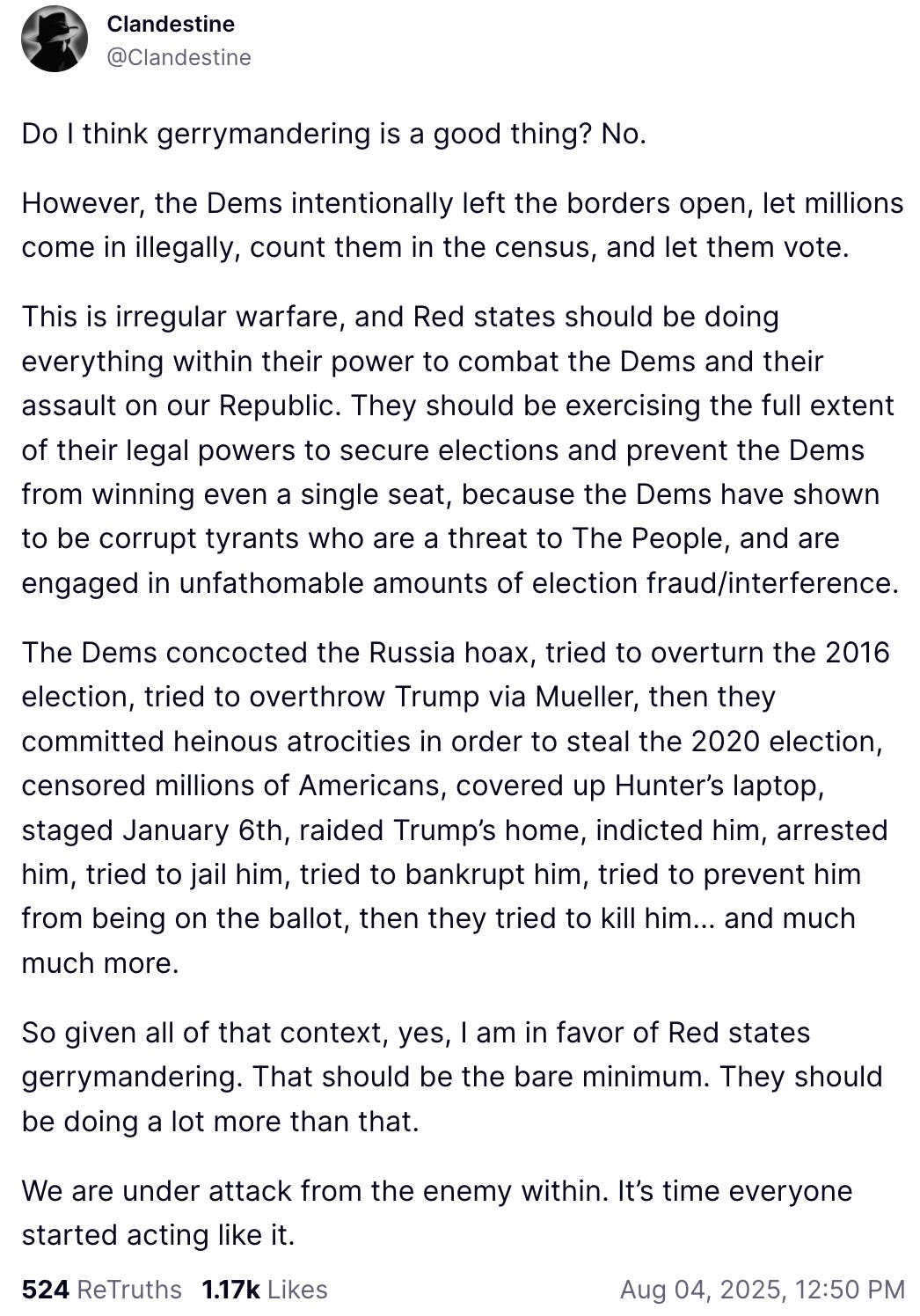
Caption: Jacob Creech (aka “Clandestine”) argues that he supports redistricting efforts as a form of “irregular warfare” against Democrats in a Truth Social post shared on Aug. 4, 2025.
This attitude can also be seen in this Telegram post, shared on Dec. 5, 2025:
We don’t care, if we don’t fix redistricting then everything MAGA falls apart. GROWUP
Fairness Narratives
Other high-engagement posts highlighted cases where Democrat-majority state legislatures enacted electoral maps that had been gerrymandered on partisan and racial lines, framing Republican efforts to do the same as an uncontroversial or justified response to a lack of representation in certain states. In many posts our researchers identified, users highlighted Democratic politicians’ alarm over Republican redistricting efforts and celebrated their apparent distress.
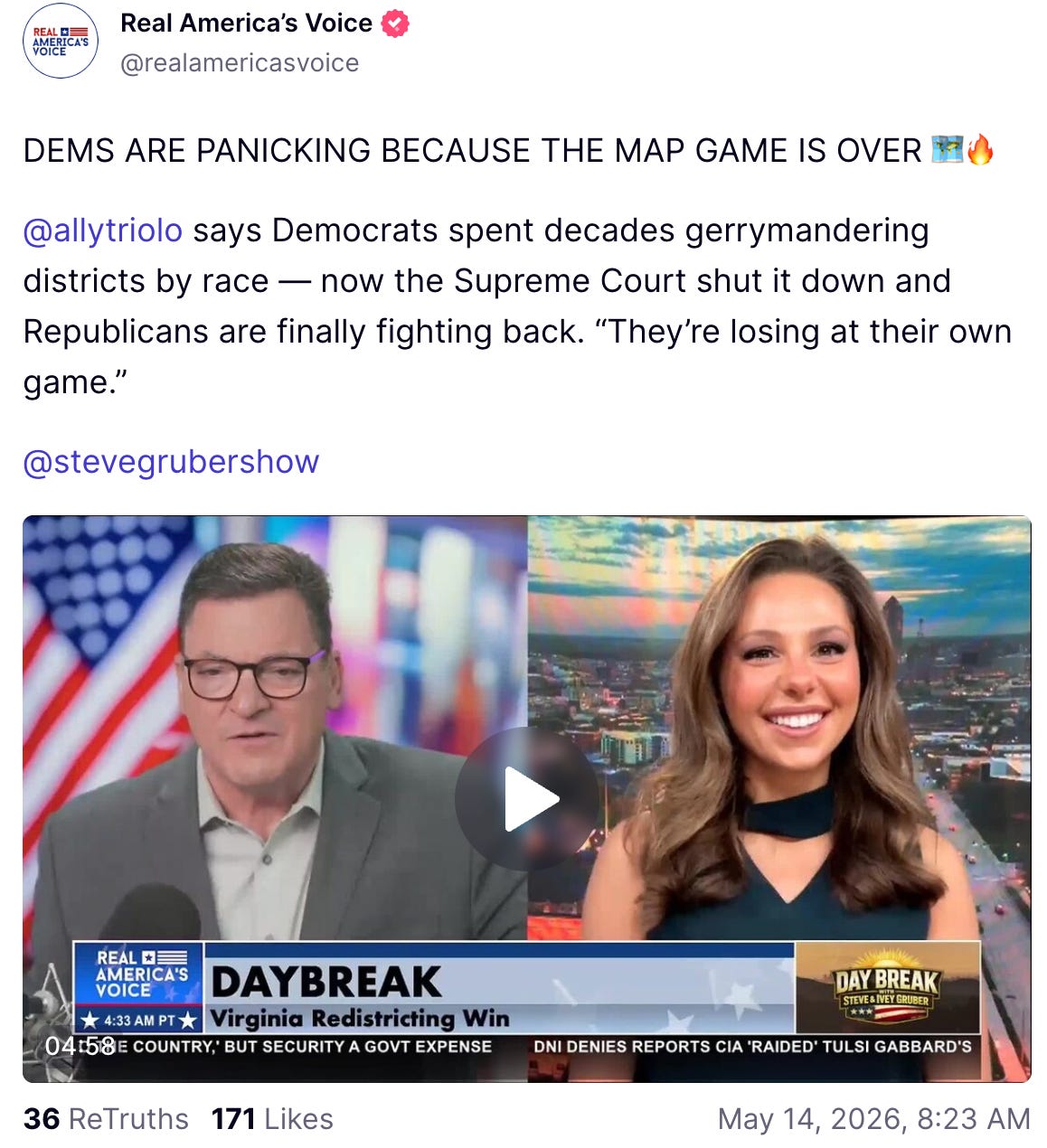
Caption: In a Truth Social post shared May 14, 2026, right-wing news company Real America’s Voice promotes a claim that Democrats spent “decades” gerrymandering election maps by race and are “PANICKING” because they are now “losing at their own game.”
Many posts insisted that Republicans were simply borrowing Democrats’ own tactics, as seen in this post on Scored on April 22, 2026:
They didn’t really start it. All Texas was doing was fixing the insanely Gerrymandered, and illegally created by Democrats, districts.
And this Scored post from Aug. 7, 2025:
Democrats gerrymander the FUCK out of blue states. No matter how you feel about it, we have to do the same in red states.
Racism Narratives
As the conservative-majority Supreme Court effectively gutted protections against racial gerrymandering in April 2026, high-engagement posts from pro-Trump social media personalities framed the decision as a victory against supposedly racist map-drawing by Democrats.
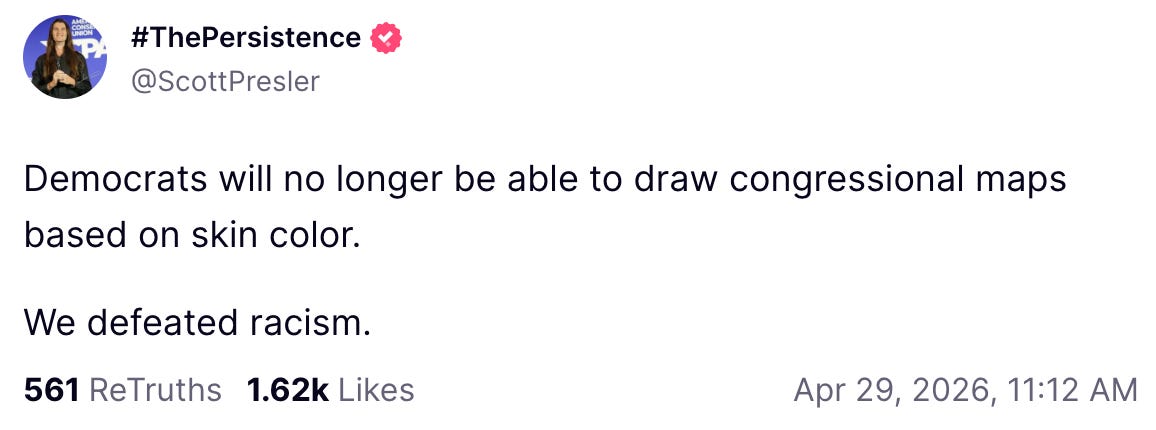
Caption: Right-wing activist Scott Presler proclaims in an April 29, 2026, Truth Social post that conservatives “defeated racism” after the US Supreme Court effectively undercut legal prohibitions against racial gerrymandering.
These narratives were also shared between platform users, as seen in this Scored post from April 30, 2026:
All that SCOTUS found on the redistricting decision is that racism doesn’t cure racism. It’s just more racism. Dems clearly need racism to win.
And this Gab post from May 10, 2026:
DEMS ARE HYSTERICAL, THEY’VE LOST SOME OF THEIR VOTER BASE, THEY’VE LOST THEIR RACIST GERRYMANDERING PLOYS, THEY’RE GOING TO LOSE MAIL-IN AND VOTER ID WILL INSURE ONLY AMERICAN CITIZENS VOTE IN OUR ELECTIONS…HOW GLORIOUS IS THAT ?
Conclusion
False narratives about the integrity of elections have driven a rise in threats against elections officials, empowered legislative efforts to restrict ballot access, and undermined public trust in democracy.¹² It is likely that discourse in communities that previously promoted similar narratives could elicit similar effects in the future, particularly in relation to current redistricting efforts and other issues pertaining to the 2026 midterm elections.
In the interest of public safety, Open Measures’ platform was designed to track these narratives and reduce the risks that their spread might inflame.
Citations
Lily Kincannon, J.D. Rackey, and Michael Thorning. “What to Know About Redistricting and Gerrymandering.” Bipartisan Policy Center. 8 August 2025. Here.
Michael Li. “Gerrymandering Explained.” Brennan Center for Justice. 10 August 2021. Here.
Joey Cappelletti and Nicholas Riccardi. “Trump tells Texas Republicans to redraw the state congressional map to help keep House majority.” Associated Press. 15 July 2025. Here.
David A. Lieb. “Redistricting is rampant ahead of the US House midterm elections. What states are taking action?” Associated Press. 5 May 2026. Here.
Ari Berman. “After SCOTUS Destroyed the Voting Rights Act, Southern States Rush to Pass Jim Crow Voting Maps.” Mother Jones. 7 May 2026. Here.
Alexander Rossell Hayes. “Large majorities of Americans say gerrymandering is a major problem, unfair, and should be illegal.” YouGov. 8 August 2025. Here.
David Danelski. “Gerrymandering erodes confidence in democracy.” UC Riverside News. 12 August 2025. Here.
Jem Bartholomew. “Going Nuclear.” Columbia Journalism Review. 6 May 2026. Here.
Huo Jingnan. “Gateway Pundit files for bankruptcy after election conspiracy defamation lawsuits.” NPR. 24 April 2024. Here.
Barbara Rodriguez. “Voting may be over, but this election worker is still debunking disinformation.” The 19th. 18 November 2024. Here.
Hansi Lo Wang. “Trump wants a new U.S. census to exclude people here illegally. It’d be unprecedented.” NPR. 7 August 2025. Here.
“Local Election Officials Survey 2026.” Brennan Center for Justice. 13 April 2026. Here.
Identify online risks with the Open Measures platform.
Organizations use Open Measures every day to track trends related to networks of influence, coordinated harassment campaigns, and state- backed info ops. Click here to book a demo.