
US Olympians' Discomfort with American Politics Met with Online Hate and Harassment
Attacks on female athletes were severe and more sustained, including misogynistic abuse and explicit AI ‘deepfakes’
TLDR
Athletes representing the United States in the 2026 Olympic Winter Games have faced partisan backlash for voicing concerns about US politics under the Trump Administration.
Team USA Olympians who raised these concerns were met with hate and harassment on a variety of right-leaning alt-platforms, where discussions had often been enflamed by US political and media figures.
Online harassment of female athletes was particularly harsh and more sustained, including misogynistic comments and nonconsensual, sexually explicit “deepfake” images made with AI.
Background
The 2026 Olympic Winter Games hosted athletes from 92 countries in Milan and Cortina d’Ampezzo, Italy, from Feb. 6–22. Olympic events often see a range of political and social commentary occur on their sidelines, and at this year’s events, a sizable portion of those criticisms were levied against the United States.¹
A number of athletes representing the US publicly expressed mixed emotions about loving their country while disapproving of the Trump Administration’s political agenda.² These and similar comments elicited backlash from US political leaders and partisan media outlets, as well as online abuse and harassment against the athletes themselves.³
Methodology
Open Measures sought to identify and analyze online hate directed at Team USA athletes who voiced their concerns about US politics while competing there. To identify these Team USA athletes, our researchers reviewed recent news media reporting, which resulted in the following list:
Hunter Hess, a freestyle skier who told reporters that he felt “mixed emotions” representing the US in light of “things going on back home” that he didn’t support. (President Donald Trump responded with a post on Truth Social calling Hess “a real Loser” and saying it was “too bad” that he was competing on behalf of the US.)
Chris Lillis, a freestyle skier who said he was “heartbroken about what’s happening” when asked about protests against federal immigration enforcement agents.
Amber Glenn, a figure skater who said LGBTQ+ communities were having a “hard time” under the Trump Administration.
Rich Ruohonen, a curler who said the Trump Administration’s violent immigration crackdown in Minneapolis “is wrong.”
Svea Irving, a freestyle skier who said it was “a tough time in our country right now.”
Maddie Mastro, a snowboarder who said she was “saddened with what’s happening at home.”
Chloe Kim, a snowboarder who defended her fellow athletes for voicing their concerns about US political issues like immigration.
Mikaela Shiffrin, an alpine skier who said it was “tough to reconcile” representing the US.
From this list, our researchers created a Boolean search string to identify posts that mentioned at least one of these athletes by name:
Finally, we used this string to search 19 unique platforms with sizable US right-wing communities – including image boards like 4chan, forums like Scored, video platforms like Rumble, and microblogging sites like Truth Social – for matching posts made between Feb. 1 and 18, 2026.
Research
From our 19 crawled sources, our researchers identified 647 posts mentioning at least one of the eight athletes in our query above, the majority of which had been shared on Truth Social (26.3%), 4chan (15.8%), or Gab (15.2%).
Across those three platforms, the most-mentioned athletes were Hess (about 45%), Glenn (about 31%), and Kim (about 12%). Our researchers also noted that the number of posts discussing the five female Olympians appeared at a steadier pace over the analysis period than posts discussing the three male athletes.
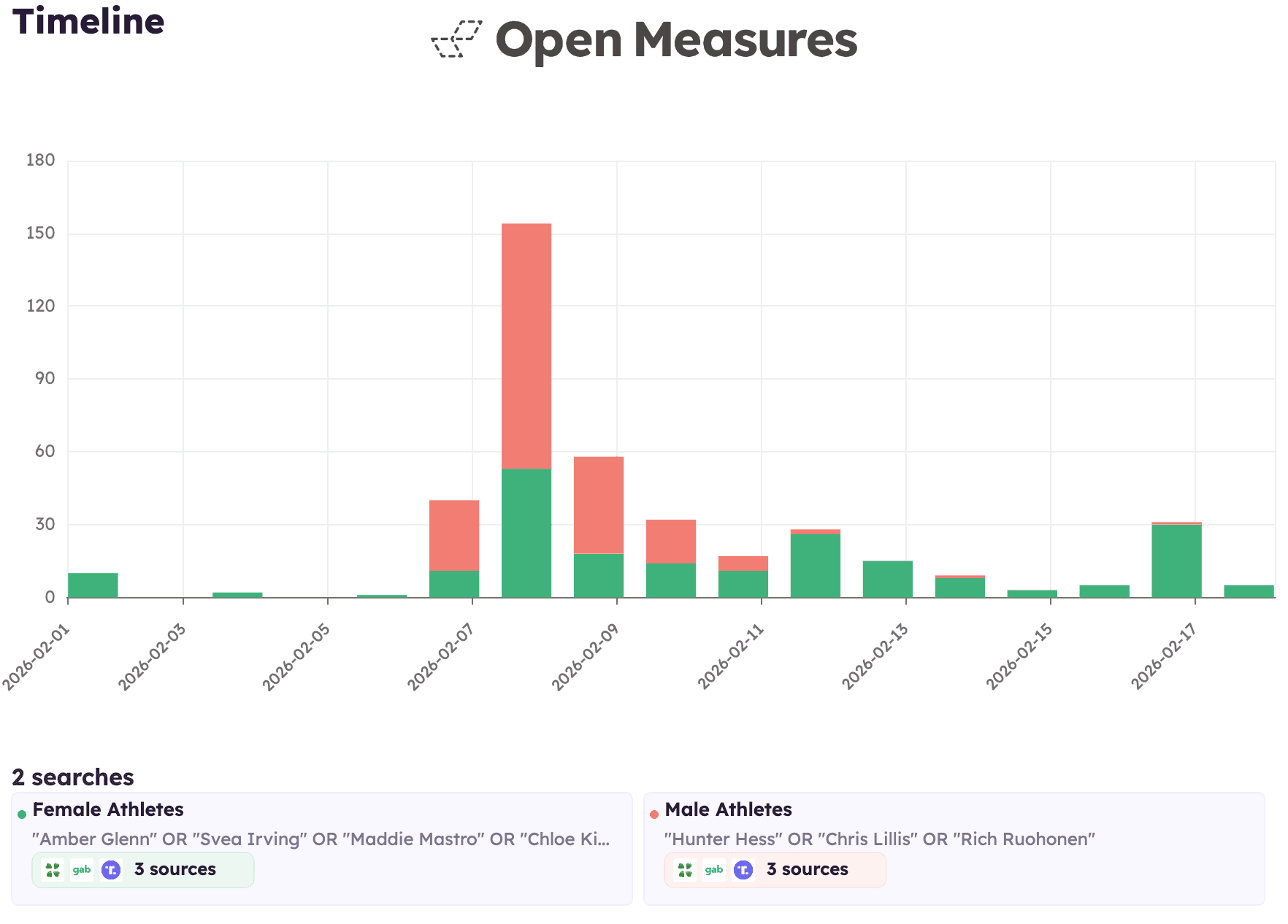
Caption: A Timeline chart showing the number of posts per day that mentioned any of the eight Team USA athletes included in our search query on Truth Social, 4chan, and Gab, the three platforms with the greatest number of posts mentioning one of these athletes between Feb. 1–18, 2026, with results grouped as female vs. male mentions.
4chan Users Trade Nude ‘Deepfake’ Images of Female Olympians
Using our platform’s “Discover” tool, our researchers manually reviewed the identified posts and found many were from 4chan threads where users discussed the nonconsensual use of generative AI tools to produce nude and sexually explicit “deepfake” images of female Olympians. In these threads, 4chan users often shared advice regarding tools and techniques they used to generate their images and shared their results with one another.
Our researchers found additional 4chan threads where users traded graphic sexual fantasies about female athletes, or attacked the same athletes for their romantic relationships with Black partners.
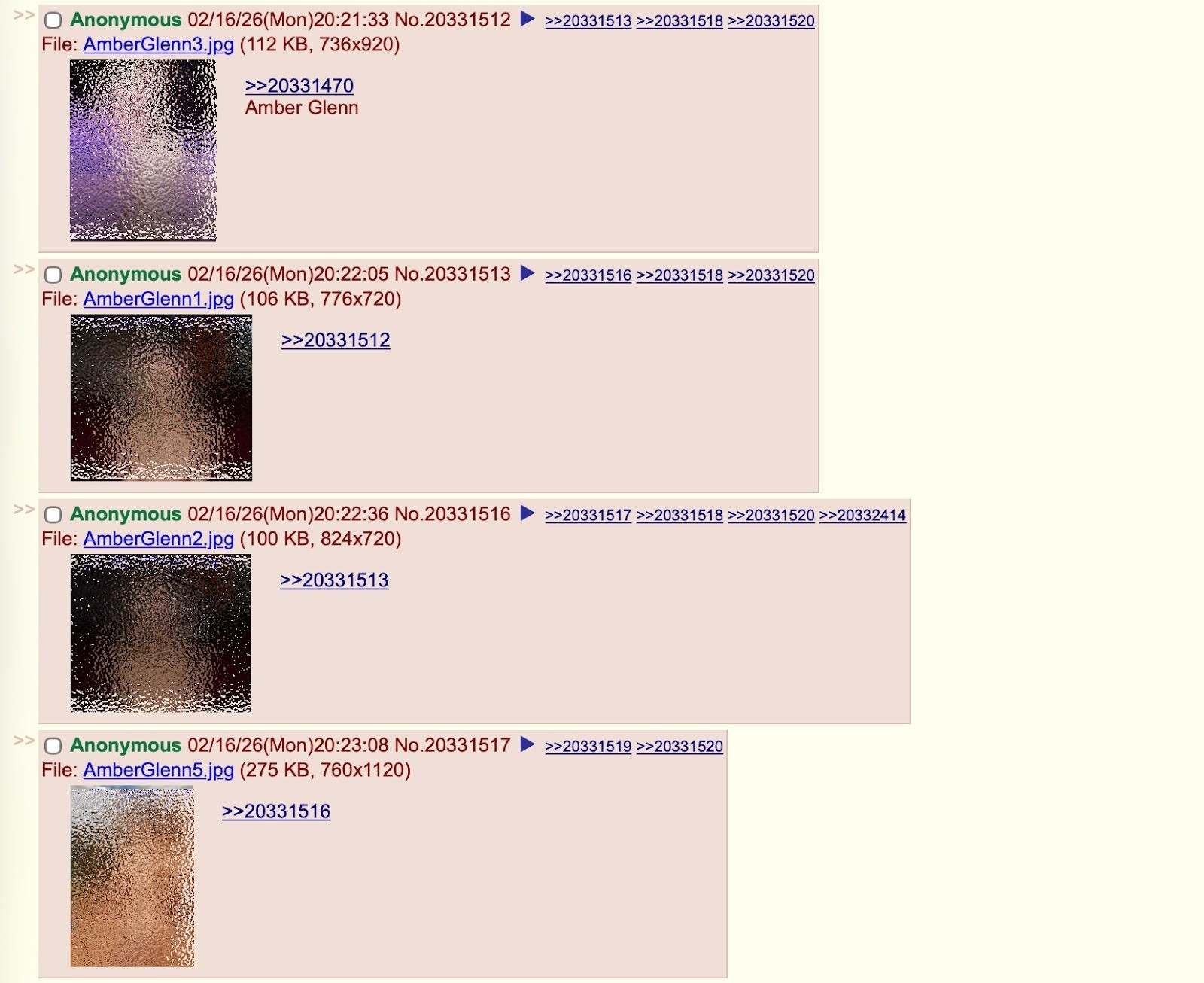
Caption: Screenshot of a 4chan thread identified by Open Measures researchers where users traded nonconsensual “deepfake” nude images of Team USA athletes produced by generative AI programs. (Open Measures has censored the images included in the thread to protect the privacy of the athletes the images depicted.)
Partisan Outlets and Themes Found In Hateful Rhetoric Against Athletes
Using “Discover,” our researchers found that many of the identified posts included links to articles from partisan news media outlets that criticized the athletes’ political comments (alongside similar user commentary that denounced those athletes).
Of the athletes included in our query, Hess and Glenn were subjected to the highest volumes of hateful comments. In Hess’s case, President Trump’s Truth Social post disparaging his political remarks seemed to spur further outrage among online pro-Trump communities.
Glenn’s pansexual identity was a significant source of online outrage as well, with a small number of posts we identified expressing violent fantasies against her (e.g., a 4chan post of a user hoping Glenn “falls and splits her head on the ice” – though researchers did not identify any posts that signaled an immediate physical threat to any of the athletes in their search string).
Most posts voiced general hostility toward the athletes, with several accusing Hess of being a disgrace to his country and calling on Team USA to eject him from the 2026 Olympic Winter Games. For example, a Feb. 8 post on Truth Social read:
Make Hunter Hess INFAMOUS, the weasel is a traitor. Stay in Europe, you are no longer welcomed in America.
Others mocked athletes who failed to win their events. For example, a Feb. 12 post on 4chan read:
Elieen Gu and Chloe Kim failed to win gold
That’s what you get for talking shit.
MAGA!
A handful of posts called for a boycott of any company that sponsored Olympians voicing concerns related to the Trump Administration. For example, a Feb. 9 post on Gab read:
If any of these commie f****ts wins a medal and comes back to the USA and some company hooks them up with an endorsement... I WILL BOYCOTT THE F*** OUT OF EVERYTHING THEY SELL
Conclusion
Online abuse targeting competitive athletes has intensified in recent years, threatening their safety, wellbeing, and performance.⁴ Political and media blowback can complicate these dynamics, marking athletes as possible targets for broader political grievances and thus getting the attention of more malicious online communities.⁵
The issue is significant enough that several professional sports organizations, including the International Olympic Committee, have responded by investing in new programs to detect and mitigate online threats.⁶ Despite these efforts, athletes continue to report feeling overwhelmed by the scale of the hate and harassment they face on social media.⁷
Identify online risks with the Open Measures platform.
Organizations use Open Measures every day to track trends related to networks of influence, coordinated harassment campaigns, and state- backed info ops. Click here to book a demo.