
New Product: Research Assistant
An AI-powered workflow for processing large datasets, identifying key patterns, and generating actionable reports – all in one window
Introduction
Open Measures is excited to introduce Research Assistant, an all-in-one interface for navigating our datasets more quickly, seamlessly, and transparently, without sacrificing accuracy or human judgment.
Research Assistant harnesses Discover, Timeline, and Activity to deliver greater insights and results than any one of our tools can produce in isolation while remaining grounded in relevant data from Open Measures’ platform. Research Assistant builds on researchers’ existing workflows to help them move from topic or question to finished report in minutes or hours rather than weeks.
What it is:
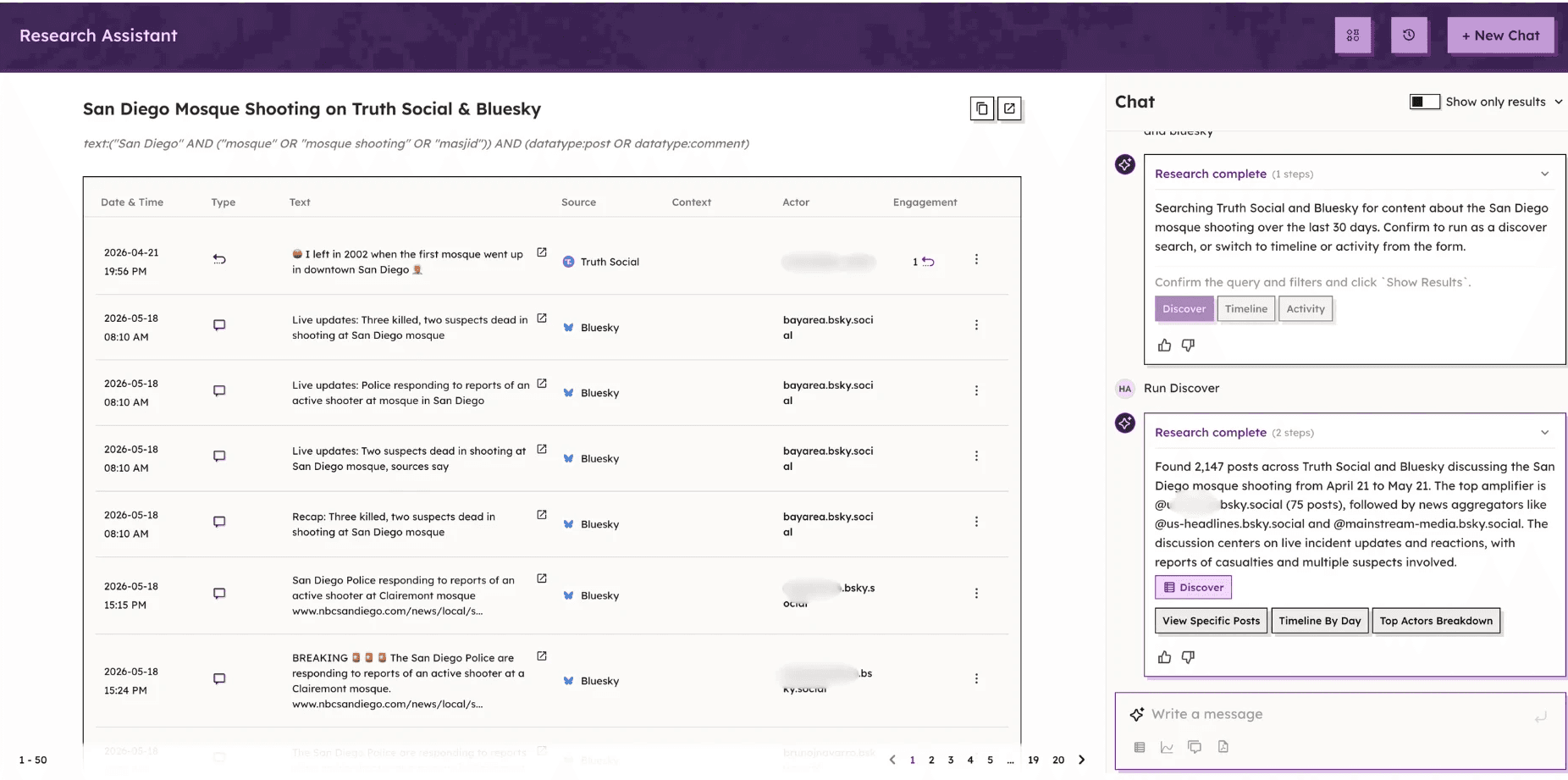
A faster way to analyze large datasets. With natural language processing, AI Research Assistant can synthesize information from thousands of posts quickly, extracting novel insights, narrative trends, and detailed patterns.
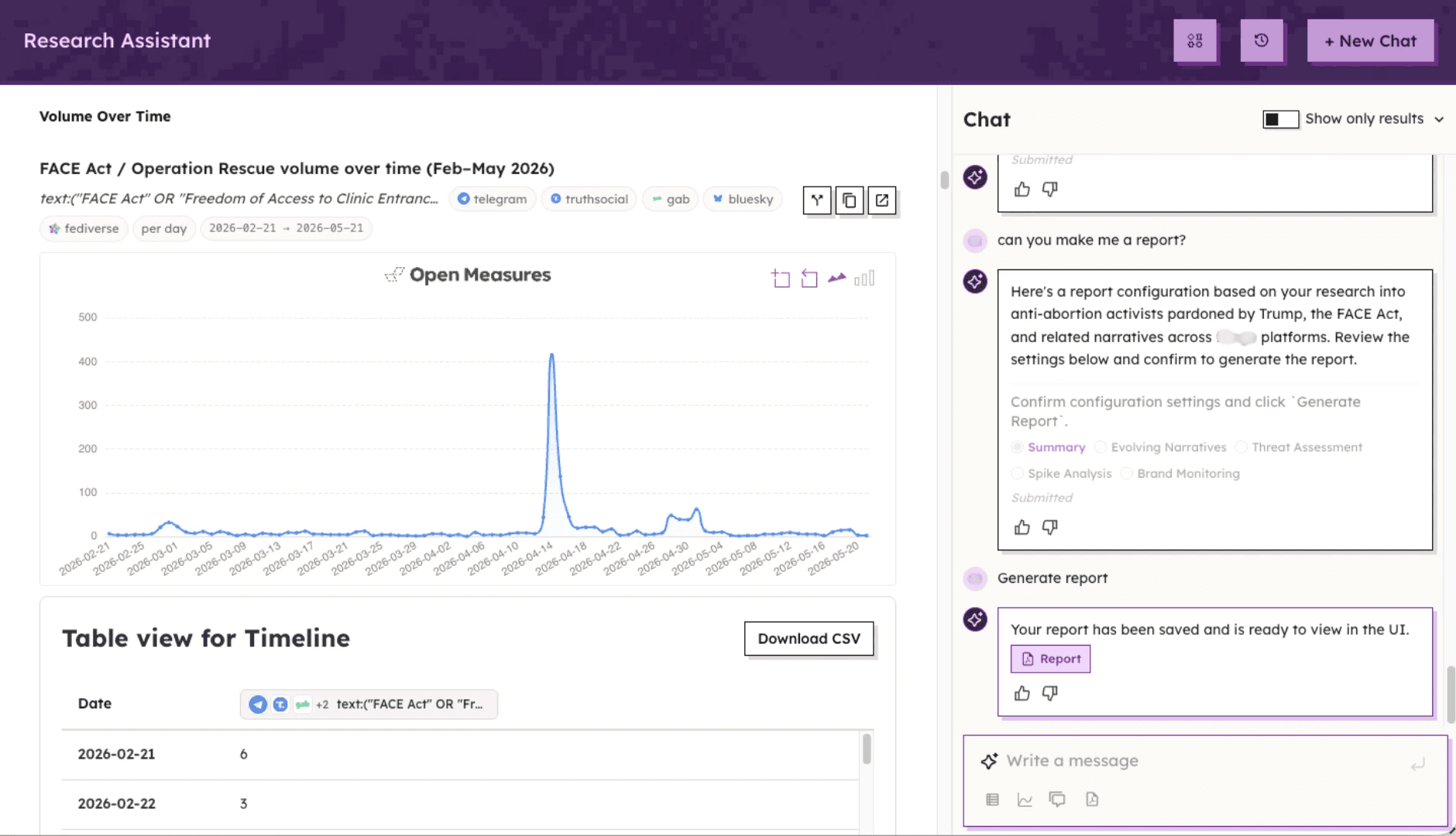
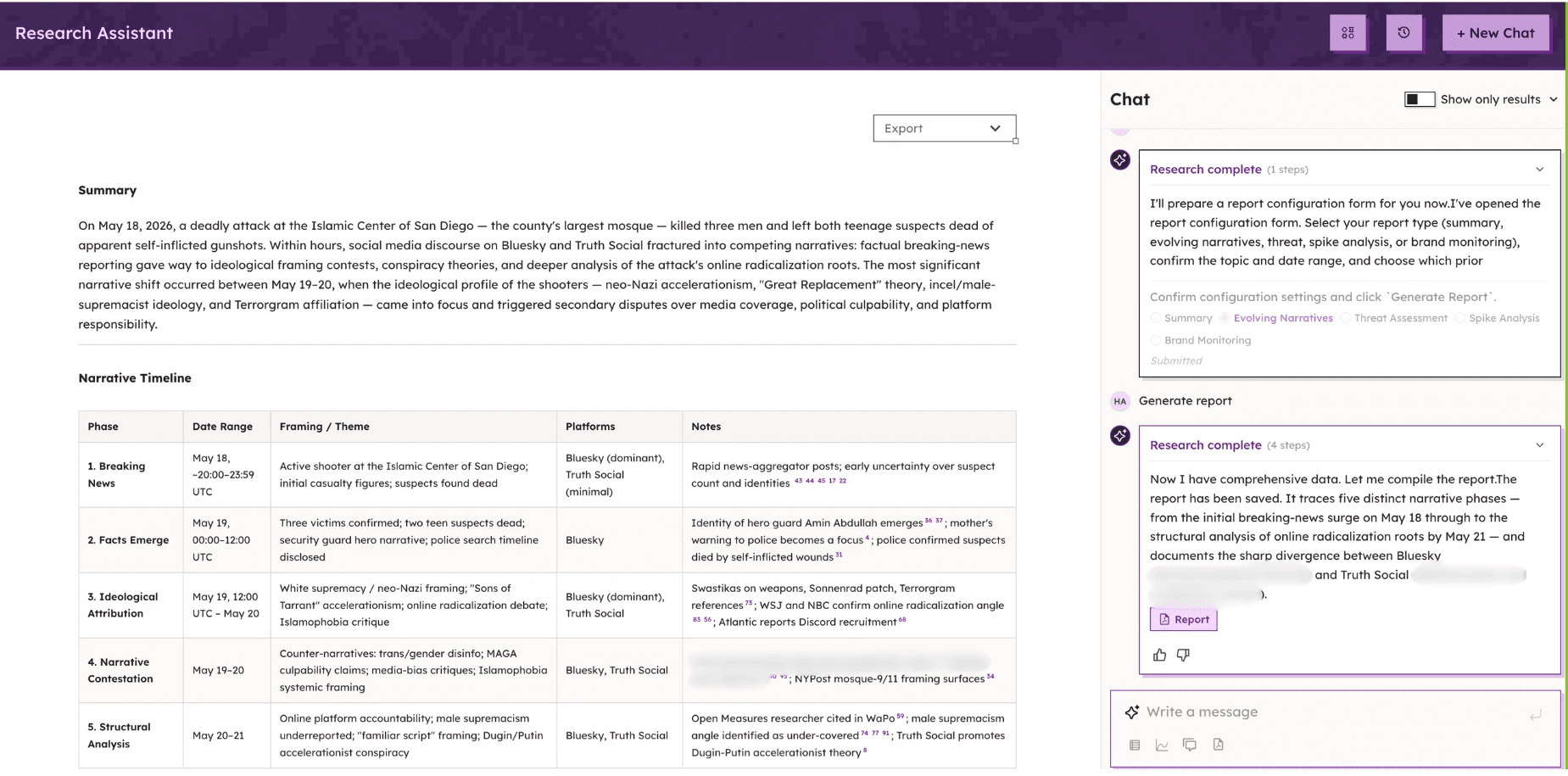
A faster way to produce actionable reports. After quickly gathering critical insights from many large datasets, Research Assistant can help draft comprehensive, shareable reports in five different formats – Summary, Evolving Narratives, Threat Assessment, Spike Analysis, and Brand Monitoring – with the click of a button.
A simpler way to use Discover, Activity, and Timeline. Instead of manually reviewing posts, exporting spreadsheets, or toggling between views, researchers can run their entire workflow from one interface.
What it’s not:
A general-purpose chatbot. Research Assistant draws from Open Measures’ data, preventing hallucinations and ensuring researchers’ expertise and judgment are still essential (by design). It is also not overly personified - we’ve intentionally named it “Research Assistant” (not “Gizmo” or “Steve,” for example).
A replacement for researchers. Research Assistant uses our platform’s features on researchers’ behalf, reducing friction, allowing them greater access to our platform, accelerating their workflows, and compounding on their expertise.
Our Philosophy
With AI adoption now in countless workflows and many sectors of the economy, AI Research Assistant intends to bring the positives of AI natively into our platform thoughtfully and responsibly. As such, we designed AI Research Assistant carefully to reflect Open Measures’ values. After many conversations with employees, customers, and stakeholders, we identified four key ideas that guided our approach:
Human-in-the-lead. The user manually controls every step, with the tool showing the underlying queries it will run before it runs them (and asking what results to include in a report). Conclusions are traceable back to real data, and researchers’ domain expertise and query skills remain central (and are not compromised or replaced by the tool).
Flexible, not prescriptive. Research Assistant does not presume one workflow or one way of presenting results. Instead, it is a non-technical and intuitive interface that supports many different workflows and levels of AI fluency.
Trustworthy and reliable. Designed not to use web search, Research Assistant draws from real data from Open Measures platform using RAG architecture to reduce hallucinations and promote researcher privacy.
Transparency without sacrificing speed. New insights generated by Research Assistant are paired with the search queries that produced them, allowing researchers to verify them independently. While the tool does greatly speed up research workflows, it does not transform them into a “black box.”
Product Features
Key capabilities include:
All-in-one interface: Researchers can combine complex Discover, Timeline, and Activity searches in one chat-based workspace without switching between tools.
Novel insights and reports: Research Assistant can expand on researchers’ insights, make insights of its own, and generate five types of reports: summary, narrative tracking, threat assessment, spike analysis, and brand monitoring.
Transparent queries: Every insight the tool generates is mapped onto precise queries that users can review, edit, or rerun.
Branching conversation paths: Each message ends with options for next steps in a way that branches, allowing users to backtrack to any decision point.
Multi-agent architecture: To balance speed, accuracy, and cost, Research Assistant automatically switches between models for queries and reporting.
Use Cases
Tracking Narrative Surges Across Platforms
Situation: A communications teams notices a new conspiracy narrative gaining traction and wants to quickly understand if or how it’s developing on multiple fringe platforms like 4chan and Telegram.
Role of the tool: Research Assistant generates platform-specific queries, retrieves relevant posts, summarizes the dominant patterns from each platform, and produces comparative timelines - with the researcher approving each decision at each step.
Impact: Without toggling between many windows and posts, the team gains a cross-platform understanding of where the narrative came from and where it might spread almost instantly, giving them a head start on deeper investigations.
Enhancing Reports with Graphs and Artifacts
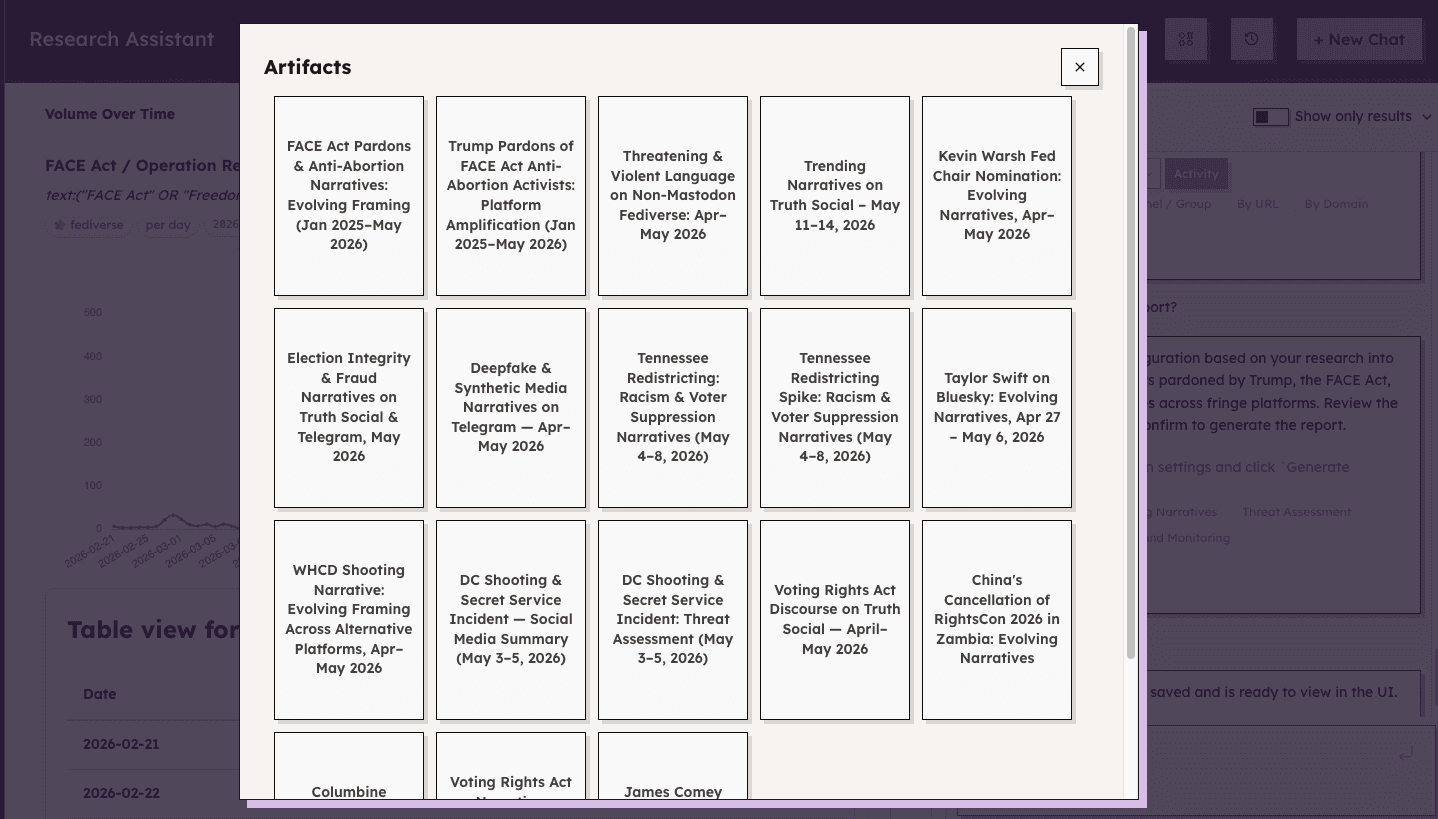
Situation: A security analyst under a tight deadline needs to gather cross-platform research to create a comprehensive trend analysis report for an important stakeholder, complete with visualizations, specific examples, and info-driven summaries.
Role of the tool: Using Research Assistant, the analyst makes suggestions, receives queries to approve and execute, and gathers a wealth of cross-platform information (using the tool’s branching structure to explore many different queries in parallel at various depths). When satisfied, the analyst has Research Assistant generate a comprehensive trend report with graphs and individual posts cited.
Impact: The analyst gives a polished deliverable grounded in concrete data to the stakeholder ahead of their deadline, helping the stakeholder in a crucial upcoming meeting and improving collaboration across teams.
Beyond primary use cases, Research Assistant also supports many complementary workflows:
Crawl Requests: When a query finds no relevant posts, users can submit new Crawl Requests directly through the chat window.
Labels: Upon finding an important channel, post, or actor, the user tells Research Assistant to add a custom label to it.
Post and link extraction: From broad data, the user requests the top five posts by engagement – or extracts URLs from all of the content at once.
Harm reduction. While browsing potentially harmful data, Research Assistant warns the user about traumatic images or posts rather than showing them automatically.
Looking Ahead
Research Assistant was built to bring the power of AI into the Open Measures platform while keeping researchers in control of the context. We see this as a foundation that we’ll continue to refine and improve based on user feedback. Above all, Research Assistant will always be designed to enhance and preserve human judgment, expertise, and accuracy rather than replacing it.
Due to costs of running and maintaining Research Assistant, it is unlikely to be incorporated into the public, open-source version of Open Measures. For more information on bringing Research Assistant to your organization, reach out to schedule a demo.
Identify online risks with the Open Measures platform.
Organizations use Open Measures every day to track trends related to networks of influence, coordinated harassment campaigns, and state- backed info ops. Click here to book a demo.